
Cooling Towers for Data Centers
Engineered for mission-critical cooling loads, 24/7 operation, and the thermal demands of modern data center infrastructure.
The Challenge
The cooling challenge in data centers
Modern data centers reject more heat per square foot than nearly any other commercial environment. Rack densities have climbed from 5–10 kW per cabinet to 30, 40, and even 100+ kW in high-performance computing and AI workloads. That heat has to go somewhere — and air cooling alone often can’t keep up.
Cooling towers play a critical role in the heat-rejection chain. They remove waste heat from chilled water loops feeding CRAH and CRAC units, allowing chillers to operate efficiently and keeping IT equipment within ASHRAE TC 9.9 thermal guidelines. For data center operators, the cooling system has to deliver on four non-negotiable requirements:
01
Continuous operation
No scheduled downtime tolerance.
02
Redundancy
N+1, N+2, or 2N configurations to prevent single points of failure.
03
Water efficiency
Especially critical in arid climates and water-stressed markets.
04
Energy efficiency
Cooling is one of the largest operational expenses in any data center. For most facilities, the cooling tower is where the biggest efficiency gains and cost reductions are found.
System Architecture
How cooling towers fit into data center cooling
The chiller transfers heat from the IT environment to the condenser water loop, which is sent to the cooling tower for evaporative heat rejection — the final hand-off in the chain.
→
CRAH / CRAC
→
Chilled water
→
Chiller
→
Condenser water
→
Cooling tower
Common configurations
- Open-loop evaporative cooling towers paired with water-cooled chillers
- Closed-loop fluid coolers for facilities that require isolation between process and ambient water
- Waterside economization allowing free cooling when ambient wet-bulb temperatures permit
- Hybrid systems combining evaporative cooling with dry cooling for water-constrained sites
CTS works with mechanical engineers and design-build firms to size and specify the right cooling tower for the project’s heat load, redundancy strategy, and site constraints.
Heat Load
Sizing a cooling tower for data center heat loads
Almost every watt that goes into a server leaves as heat, and the cooling tower is where that heat finally leaves the building. In a water-cooled plant, the tower has to reject the IT load plus the work the chillers add to move that heat. That makes the tower’s heat rejection load larger than the IT load itself.
From kW of IT load to tower capacity
- 1 kW of IT load = 3,412 BTU/hr = about 0.28 refrigeration tons.
- Heat of rejection. An electric chiller adds its compressor energy to the condenser loop. A common planning factor is 1.25, meaning the tower rejects about 15,000 BTU/hr for every ton of cooling the chiller delivers. That is the basis of a “nominal cooling tower ton.”
- Add non-IT loads. UPS and transformer losses, lighting, and people add heat inside the white space. Include them in the design load, along with planned growth.
- Design to the site wet bulb. CTS ratings are based on 95°F hot water, 85°F cold water, and a 75°F wet bulb. A hotter or more humid site, or a tighter approach, needs more tower. Our engineers correct for your actual design conditions.
Example selections from the CTS T-2 line
The table uses the 1.25 heat-of-rejection factor and standard CTS rating conditions. It is a starting point for budgeting, not a final selection.
| IT load | Tower heat rejection | Single tower (N) | N+1 option |
|---|---|---|---|
| 250 kW | ≈1,066,000 BTU/hr (71 tons) | T-280 (1,200,000 BTU/hr) | 3 × T-250 (any 2 carry 1,500,000) |
| 500 kW | ≈2,133,000 BTU/hr (142 tons) | T-2150 (2,250,000 BTU/hr) | 3 × T-280 (any 2 carry 2,400,000) |
| 1 MW | ≈4,265,000 BTU/hr (284 tons) | T-2300 (4,500,000 BTU/hr) | 3 × T-2150 (any 2 carry 4,500,000) |
| 2 MW | ≈8,530,000 BTU/hr (569 tons) | T-2600 (9,000,000 BTU/hr) | 3 × T-2300 (any 2 carry 9,000,000) |
Models T-23 through T-280 ship completely assembled, so smaller edge and enterprise sites can often set their towers in a single day. See the full Model T-2 range and our guide on how to size a cooling tower.
Airflow Management
Hot aisle / cold aisle containment and the cooling tower
Hot aisle and cold aisle containment look like a white-space decision, but they change what the cooling tower is asked to do.
- Containment stops mixing. Without it, hot exhaust air mixes with cold supply air, and operators compensate by over-cooling. With it, the cooling units see hotter, more consistent return air and can supply air closer to the server inlet limit.
- Warmer supply air allows warmer chilled water. The ASHRAE TC 9.9 recommended server inlet range runs up to 80.6°F (27°C). Plants serving contained rooms commonly raise chilled water temperatures well above traditional comfort-cooling setpoints.
- Warmer chilled water lowers chiller lift. The chiller works against the difference between chilled water and condenser water temperatures. Raise the first, or lower the second with a well-performing tower, and compressor energy drops.
- More free-cooling hours. With a waterside economizer, the tower cools the chilled water loop through a plate-and-frame heat exchanger whenever the outdoor wet bulb is low enough. Warmer chilled water setpoints greatly expand those hours, and the tower becomes the main cooling source for much of the year.
The takeaway for the tower: in a contained, economizer-equipped plant, the tower runs year-round and often carries the entire load in cold weather. That raises the importance of freeze protection, corrosion resistance, and reliable fans. See our guides on cooling tower freeze protection and basin immersion heaters.
Efficiency
How the cooling tower affects PUE
Power usage effectiveness (PUE) is total facility energy divided by IT energy. A PUE of 1.5 means that for every 1 kW of IT load, the facility uses another 0.5 kW for cooling, power distribution losses, and everything else. Cooling is usually the largest piece of that overhead.
Where the tower moves the number
- Colder condenser water, more efficient chillers. Chiller efficiency typically improves by roughly 1–2% for every 1°F drop in entering condenser water temperature, depending on the chiller. A tower that holds its design approach delivers that benefit every hour it runs.
- Low fan power. The 250-ton T-2250 uses a 7.5 HP fan motor, or 0.03 HP per nominal ton. Tower fans are a small share of plant energy, but they run continuously, so every horsepower counts.
- VFDs and the fan affinity laws. Fan power varies roughly with the cube of fan speed. A fan at 50% speed uses about 12.5% of full power. Running all towers at reduced speed, instead of running fewer towers at full speed, usually saves energy and keeps water flowing over all the fill.
- Performance that does not degrade. Corroded casings, sagging fill supports, and clogged distribution all raise condenser water temperature over time. FRP construction keeps the structure intact for the life of the tower, which protects the PUE you designed for.
Water use matters too. Many operators now track water usage effectiveness (WUE) alongside PUE. Running higher cycles of concentration cuts blowdown, and FRP tolerates the water chemistry that higher cycles require better than galvanized steel. See the 20-year total cost of ownership for FRP cooling towers for a worked example.
Resilience
Designing cooling tower redundancy
A data center cannot shut down its cooling plant for maintenance. Redundancy at the tower level is what makes that possible.
| Approach | What it means | Typical use |
|---|---|---|
| N | Just enough tower capacity for the design load. | Non-critical loads only. |
| N+1 | One extra tower or cell, so any one unit can be offline. | The most common choice for enterprise and colocation sites. |
| N+2 | Two extra units, covering one failure during planned maintenance. | Larger or higher-tier facilities. |
| 2N | Two fully independent systems, each able to carry the whole load. | Highest-availability facilities. |
Practical design points
- Several smaller towers often beat one large tower. Three towers sized so that any two carry the load give N+1 with only 50% extra capacity. Two full-size towers give N+1 with 100% extra capacity.
- Isolate each tower. Provide isolation valves on supply and return, and plan basin equalizer lines so that water levels stay balanced when towers share a common header.
- Match pumps and electrical to the tower strategy. Redundant towers do little good if they share one pump, one motor control center, or one power feed.
- Plan for maintenance access. Leave room for fan, motor, and fill service on each unit. CTS publishes replacement parts by model, so spare motors and fill can be stocked on site.
- Use factory-assembled towers. They install in hours or days instead of weeks, so adding or replacing a unit does not mean a long construction period inside an operating site. See factory-assembled vs field-erected cooling towers.
For more on how the cooling plant fits into the facility, read our article on data center thermal management.
Why FRP
Why FRP cooling towers are the right choice for data centers
Corrosion resistance
FRP doesn’t rust, scale, or corrode galvanically. With water-treatment chemicals running 24/7 for the life of the facility, corrosion is the leading cause of premature tower failure — FRP eliminates that risk.
Lower total cost of ownership
FRP towers routinely deliver 20–30+ years of service vs. 10–15 for galvanized steel. CTS is the only manufacturer to back its towers with a 20-year warranty — lower maintenance, no recoating, no rust mitigation. There’s a reason data center engineers keep coming back to us, and it goes beyond the warranty.
Energy efficiency
The CTS T-2 counterflow induced-draft design reduces required fan horsepower per ton of cooling. Lower kWh means lower PUE, lower OpEx, and a faster ROI on the cooling investment.
Thermal performance
Engineered fill media, optimized water distribution, and high-efficiency drift eliminators maximize heat rejection in the smallest possible footprint — critical where data center site space is constrained.
Quiet operation
Lower fan tip speeds and optional low-noise packages help data centers meet local noise ordinances, especially in suburban or mixed-use locations.
Lighter installation
FRP construction is significantly lighter than steel, simplifying rigging, structural loading, and rooftop or elevated-deck installation.
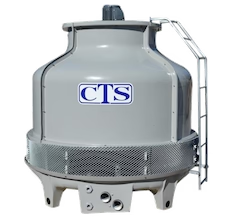
The CTS T-2 Counterflow Cooling Tower
Flagship Tower
Specified into data center projects nationwide
The T-2 is our flagship counterflow induced draft cooling tower, specified into data center projects across the U.S. and internationally.
Standard features
- Fiberglass reinforced polyester (FRP) shell and structural components
- Counterflow induced draft design for maximum thermal efficiency
- High-efficiency PVC fill media
- Pressurized water distribution system
- Stainless steel hardware
- Drift eliminators with industry-leading efficiency
Optional features
- Low-noise fan packages
- Redundant cell configurations
- Custom capacity sizing per project
- Cold-water basin — CTS uses non-corrosive FRP, so a stainless-steel basin isn’t required.
- Vibration switches & capacity controls — available, though CTS fans are balanced and tested before installation, so vibration isn’t a concern.
Comparison
FRP vs. galvanized steel for data center cooling towers
| Factor | FRP (CTS) | Galvanized steel |
|---|---|---|
| Corrosion resistance | Excellent — non-corrosive by design | Moderate — zinc coating degrades over time |
| Service life | 20–30+ years | 10–15 years typical |
| Maintenance | Minimal | Routine rust treatment and recoating |
| Weight | Lighter — easier rigging and installation | Heavier |
| Initial cost | Higher | Lower |
| Lifecycle cost | Lower | Higher |
| Chemical compatibility | Compatible with most water-treatment chemistries | Sensitive to aggressive water chemistry |
For 24/7 mission-critical applications, the total cost of ownership advantage of FRP is decisive.
Applications
Data center applications we serve
- Colocation facilities
- Hyperscale data centers
- Enterprise data centers
- Edge data centers
- Telecom switching facilities
- Broadcast & media operations
- AI / HPC computing facilities
- Bitcoin mining & crypto
Engineering Support
Custom sizing, concept through commissioning
Every data center project is different. Heat loads, water availability, climate, redundancy requirements, and site constraints all factor into the right cooling tower specification. Our in-house engineering team supports your project end to end.
- Thermal performance evaluations using your operating data
- Custom sizing and cell configuration
- Formal quotations with full technical specifications
- CAD drawings, cut sheets, and O&M manuals
- Replacement parts for every system we build
FAQ
Frequently asked questions
How do I size a cooling tower for my data center?
Sizing depends on the design heat load (typically expressed in tons or kW), the design wet-bulb temperature for the site, and the desired water temperature drop. CTS engineers can run thermal performance calculations using your specific operating conditions and recommend the right capacity and cell configuration.
How is FRP different from galvanized or stainless steel?
FRP is non-corrosive by design — it doesn’t rust or scale and is chemically compatible with most water-treatment programs. Galvanized steel relies on a sacrificial zinc coating that degrades over time, especially in aggressive water chemistries. Stainless steel resists corrosion better than galvanized but is significantly more expensive and still subject to chloride stress corrosion in some conditions.
Can CTS cooling towers operate in arid climates with low water availability?
Yes. CTS towers can be specified with high-efficiency drift eliminators and low-water-consumption fill media, and paired with waterside economization or hybrid dry/evaporative systems to minimize water use.
What is the warranty and expected service life of a CTS FRP cooling tower?
With proper water treatment and routine maintenance, CTS warrants 20 years on the FRP (fiberglass) casing and cold-water basins, 2 years on all PVC fill, and 1 year on all fan motors, major drive components, and internal moving parts — even under continuous-duty operation.
Do CTS cooling towers meet ASHRAE thermal guidelines?
CTS towers are designed to support condenser water temperatures consistent with ASHRAE TC 9.9 recommendations for data center cooling. Specific performance is engineered to your project requirements.
Are CTS cooling towers CTI certified?
CTS has been a member of the Cooling Technology Institute (CTI) since 1972 and rates its cooling towers to CTI specifications. CTI thermal certification is available on specified models — contact our engineering team for details on your project.
Can existing cooling towers be replaced with FRP without major infrastructure changes?
In most cases, yes. CTS provides replacement towers sized to match existing footprints, basin dimensions, and piping connections. CTS offers 14 different styles of cooling towers — including crossflow, counterflow, closed-loop, high-temp, fanless, and alternate systems. Our engineering team can review your existing installation and recommend a drop-in or modified replacement.
What is the typical lead time for a CTS cooling tower?
Lead times vary by configuration and project complexity. Standard configurations typically ship within several weeks of order; custom or larger configurations may require longer. Contact us with your timeline and we’ll provide a firm delivery schedule with your quote.
Comparison
Request a quote for your data center cooling tower
Send us your operating conditions, redundancy requirements, and site constraints, and we’ll respond with a formal quotation and technical specifications.
In-house engineering · Manufactured in Macon, GA