
Cooling Towers for Breweries & Food & Beverage Facilities
Engineered for the process cooling demands of breweries, distilleries, beverage producers, and food processing operations.
The Challenge
The cooling challenge in breweries and food & beverage production
Process cooling sits at the center of nearly every production step in a brewery, distillery, or food and beverage facility — wort cooling, fermentation temperature control, cold liquor tanks, glycol chilling, pasteurization, CIP systems, and refrigerated storage all depend on reliable, continuous heat rejection.
When the cooling system underperforms, the consequences are immediate: fermentation temperatures drift, batch quality suffers, schedules slip, and energy costs climb. Producers face a specific combination of cooling requirements:
Tight temperature control
Fermentation, lagering, and cold storage need stable water temperatures.
Continuous-duty operation
Production schedules don’t pause for cooling maintenance.
Sanitary water chemistry
Aggressive treatment programs that punish galvanized steel.
Seasonal load variation
Peak summer wort cooling plus lighter shoulder-season demand.
Energy efficiency
Utility costs are among the largest operating expenses.
System Architecture
How cooling towers fit into brewery & F&B cooling
In most production facilities, cooling towers reject heat from a glycol chiller plant or process water loop that feeds the production floor.
→
Heat exchangers
→
Glycol chiller
→
Cooling tower
Common applications
- Wort cooling through heat exchangers after the boil
- Refrigeration condenser cooling for cold storage and packaging
- Process equipment cooling — pumps, compressors, packaging lines
CTS works with brewery designers, mechanical contractors, and plant engineers to size cooling capacity that matches production volume, seasonal load profiles, and future expansion plans. The same approach applies across broader manufacturing and industrial process environments.
Why FRP
Why FRP cooling towers are right for food & beverage facilities
Corrosion resistance
Food and beverage facilities run aggressive water-treatment programs, and process water often carries mineral content, biocides, and pH variability that punishes galvanized steel. FRP is non-corrosive by design — it doesn’t rust, scale, or degrade in aggressive water chemistries.
Sanitary-friendly construction
Smooth FRP surfaces are easier to clean and less prone to biological fouling than rough galvanized. For facilities operating under FDA, USDA, or state health-department oversight, that matters.
Continuous-duty reliability
A cooling failure during peak production season can cost a brewery a full production cycle. FRP towers are engineered for continuous duty with a service life matched to a long-running production facility.
Energy efficiency
The CTS T-2 counterflow induced-draft design reduces fan horsepower per ton. Lower kWh consumption translates directly into lower utility costs on every batch produced. For production facilities, those savings add up quickly across a full operating year.
Lower total cost of ownership
FRP towers routinely deliver 20–30+ years of service vs. 10–15 for galvanized steel. CTS is the only manufacturer to back its towers with a 20-year warranty — lower maintenance, no recoating, no rust mitigation. It is worth understanding what sets Cooling Tower Systems apart before you spec your next system.
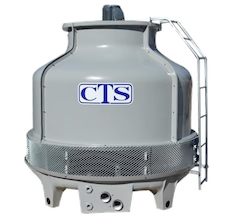
The CTS T-2 Counterflow Cooling Tower
Flagship Tower
Specified into breweries and F&B facilities nationwide
The T-2 is our flagship counterflow induced draft cooling tower, specified into breweries, distilleries, and food and beverage facilities across the country.
Standard features
- Counterflow induced draft design for maximum thermal efficiency
- High-efficiency PVC fill media
- Pressurized water distribution system
- Stainless steel hardware
- Drift eliminators with industry-leading efficiency
Optional features
- Low-Noise fan packages for noise-sensitive sites
- Multi-cell configurations for phased expansion
- Custom sizing per facility heat load
Comparison
FRP vs. galvanized steel for brewery & F&B cooling
| Factor | FRP (CTS) | Galvanized steel |
|---|---|---|
| Corrosion resistance | Excellent — non-corrosive by design | Moderate — degrades in aggressive water |
| Service life | 20–30+ years | 10–15 years typical |
| Maintenance | Minimal | Routine rust treatment and recoating |
| Sanitary cleanability | Smooth surface, easier to clean | Rougher surface, harder to clean |
| Water chemistry compatibility | Compatible with most process water | Sensitive to pH and mineral content |
| Lifecycle cost | Lower | Higher |
For long-horizon production facilities, FRP delivers a measurable total cost of ownership advantage.
Applications
Food & beverage applications we serve
- Craft & commercial breweries
- Distilleries
- Wineries & cideries
- Soft drink & bottled beverage
- Dairy & ice cream
- Juice & concentrate
- Food processing plants
- Cold storage & refrigerated warehousing
- Co-packing & contract production
Engineering Support
Custom sizing, design through operation
Every production facility has a different cooling profile. Production volume, batch size, fermentation strategy, and seasonal load all factor into the right specification. Our in-house team supports your project end to end.
- Heat load and thermal performance evaluations using your facility’s operating data
- Custom sizing and multi-cell configuration
- Formal quotations with technical specifications and drawings
- CAD drawings, cut sheets, and O&M manuals
- Replacement parts and ongoing service support
FAQ
Frequently asked questions
How do I size a cooling tower for my brewery or production facility?
Sizing depends on your total process heat load — wort cooling, fermentation jackets, glycol chilling, refrigeration condensers, and process equipment — plus the design wet-bulb temperature for your location and the water temperature drop your chiller plant requires. CTS engineers run a thermal performance calculation using your facility’s specific design data.
Can FRP cooling towers handle the water chemistry in food and beverage facilities?
Yes. FRP is non-corrosive and chemically compatible with most water-treatment chemistries, including the aggressive treatment programs common in production environments — one of the clearest advantages over galvanized steel in F&B applications.
Are CTS cooling towers suitable for sanitary process cooling?
CTS cooling towers serve the process-water and condenser-water side of operations — they’re not in direct contact with product. The smooth FRP construction is easier to clean and less prone to biological fouling than galvanized alternatives, which matters in any facility operating under sanitary standards.
Can CTS cooling towers scale with production expansion?
Yes. Multi-cell configurations let operators phase in cooling capacity as production capacity expands, and we can plan an initial installation with future expansion in mind.
How do cooling towers handle the seasonal load variation in breweries?
A tower right-sized for peak summer wort-cooling demand can run VFD-controlled fans and modulated cell operation to stay efficient during lighter shoulder-season loads.
Are CTS cooling towers compatible with glycol systems?
Yes. CTS supplies closed-loop fluid coolers and cooling towers compatible with the glycol process loops common in brewery and food-production operations.
What is the expected service life of a CTS FRP cooling tower in a production environment?
With proper water treatment and routine maintenance, CTS warrants 20 years on the FRP (fiberglass) casing and cold-water basins, 2 years on all PVC fill, and 1 year on all fan motors, major drive components, and internal moving parts — even under continuous-duty operation.
Can I replace an existing galvanized cooling tower with FRP without major infrastructure changes?
In most cases, yes. CTS provides replacement towers sized to match existing footprints, basin dimensions, and piping connections. Our engineering team reviews your existing installation and recommends a drop-in or modified replacement.
What is the typical lead time for a CTS cooling tower?
Lead times vary by configuration. Standard configs typically ship within several weeks of order; custom or larger configs may take longer. Contact us with your timeline and we’ll provide a firm delivery schedule with your quote.
Comparison
Request a quote for your brewery or food & beverage cooling tower
Whether you’re building a new production facility, expanding an existing operation, or replacing aging cooling equipment, our engineering team is ready to spec the right cooling tower for your operation.
In-house engineering · Manufactured in Macon, GA