Every cooling tower reaches a point where the repair bills start adding up and the question changes from “what needs fixing?” to “is this thing still worth fixing?” It’s one of the most consequential decisions a facility manager or plant engineer can face, and it’s rarely straightforward.
Replacing too soon wastes capital. Repairing too long wastes operating budget, risks unplanned downtime, and can quietly erode the thermal performance your processes depend on. This guide gives you a clear, practical framework for making the call.
Start With an Honest Assessment
Before you can make a sound repair-or-replace decision, you need accurate information. That means a thorough inspection, not just a visual walkthrough. You’re looking at three things:
Current condition. What components are degraded, and how severely? Fill media, basin, mechanical drive, casing, distribution system, and drift eliminators each have their own wear patterns and replacement costs.
Remaining service life. A well-maintained fiberglass or stainless steel tower can last 20 to 30 years or more. A neglected galvanized steel tower in a harsh environment may be functionally done at 15. Where is this system in its realistic lifecycle?
Performance trajectory. Is thermal performance stable, or is approach temperature creeping up year over year? A tower that required no major repairs for its first 12 years and suddenly needs three in two years is telling you something.
If you don’t have reliable inspection data, get it before making any decision. Guessing in either direction is expensive.
Signs That Repair Is the Right Call
Repair makes sense when the problem is isolated, the system is in otherwise good condition, and the cost of the fix is modest relative to the tower’s remaining value.
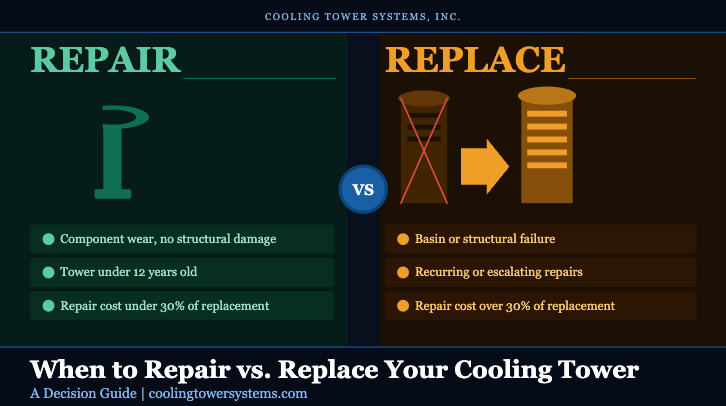
Component wear with no structural involvement
Fan blades, motors, belts, gearboxes, nozzles, and fill media are all serviceable parts with known replacement costs. If the basin and casing are structurally sound and the mechanical components are failing from normal wear, you’re looking at maintenance, not a capital decision.
The tower is less than 10 to 12 years old
A relatively young tower with a well-documented service history and good structural bones should be repaired. Replacing a 10-year-old system because a gearbox failed would be like replacing a car because it needed new brakes.
One or two systems in a multi-cell installation
If you have a four-cell tower and one cell needs a fill replacement and motor overhaul, that’s a repair job. Replacing the whole installation because one cell is degraded rarely makes financial sense.
The repair cost is under 25 to 30 percent of replacement value
This is a widely used rule of thumb in industrial equipment management. If you can restore the system to full performance for less than a third of what a new tower would cost, repair wins on pure economics.
Signs That Replacement Is the Right Call
Replacement makes sense when the problems are structural, systemic, or recurring, or when the cost-benefit math simply doesn’t work out in favor of repair.
Basin corrosion or structural failure
A corroded or cracked cold water basin is one of the clearest signals that a tower is at end of life. Patching a basin can buy time, but it rarely buys much. If the basin requires significant work, it’s worth doing a full cost comparison before committing to the repair.
Casing deterioration across multiple panels
Widespread casing damage, especially in older galvanized steel towers, means the structural integrity of the whole unit is compromised. You may patch one section only to see another fail six months later.
Recurring mechanical failures
If the same components are failing repeatedly, and especially if failures are happening outside of normal wear cycles, the tower is working too hard. That usually indicates underlying thermal performance problems, poor water chemistry management over the years, or a fundamental mismatch between the tower’s rated capacity and the actual load.
Significant thermal performance loss
A tower operating well below its rated thermal performance, after fill replacement and cleaning have been completed, may have design or structural issues that can’t be economically corrected. Quantify the efficiency loss in energy cost terms and compare it to the annualized cost of replacement.
The tower is over 20 years old with deferred maintenance
Age alone is not a reason to replace. But age combined with deferred maintenance, undocumented service history, and multiple concurrent problems changes the calculation significantly. At that point you are often paying to maintain a system toward a replacement you will have to make anyway.
Regulatory compliance or capacity changes
If you are expanding capacity, changing process loads, or facing new environmental or water treatment regulations, a replacement gives you the opportunity to right-size the system and bring it up to current standards. Retrofitting an old tower to meet new requirements is sometimes more expensive than starting fresh.
The Repair-or-Replace Decision Framework
When you are facing a specific decision, work through these five questions in order.
1. Is the structure sound? Inspect the basin, casing, and frame for corrosion, cracking, and deformation. If structural integrity is compromised, the repair math rarely works out. Jump to replacement planning.
2. What is the total repair cost? Get actual quotes, not estimates. Include all components that need attention now, and factor in any deferred items that are likely to fail within the next two to three years. That honest total is what you’re comparing to replacement cost.
3. What is the replacement cost? Get a current quote for a new tower sized to your load. Include installation, freight, downtime, and commissioning. That is your true replacement cost.
4. Apply the 25 to 30 percent rule. If total repair cost (including deferred work) exceeds 25 to 30 percent of replacement cost, replacement deserves serious consideration. If you are at 40 to 50 percent or above, replacement is almost always the better long-term decision.
5. Factor in performance and risk. Even if repair wins on pure cost, consider: What is the risk of a catastrophic failure during peak season? What does unplanned downtime cost your operation per day? Is the repaired system likely to meet your thermal requirements reliably? If the answers to those questions introduce significant uncertainty, they tip the balance toward replacement.
The Hidden Costs of Keeping a Marginal Tower Running
Facility managers often undercount the true cost of maintaining an aging, underperforming tower. Before concluding that repair is the cheaper option, account for:
Energy inefficiency
A tower operating at 80 percent thermal efficiency costs more to run every hour of every day. Over a year, that gap can be substantial, and it compounds with time.
Increased maintenance labor
An aging system demands more frequent attention. That technician time has a real cost, even if it doesn’t show up as a capital line item.
Process impact
If your cooling tower supports manufacturing, data center cooling, HVAC, or any other temperature-sensitive process, underperformance has downstream costs. Quantify what a 5-degree approach temperature increase costs your operation before assuming a repair is good enough.
Emergency repair premiums
Planned repairs cost less than emergency repairs. A tower that is limping along is more likely to fail unexpectedly, and emergency service and parts carry a premium.
When You Decide to Replace: Getting the Specification Right
If replacement is the right call, resist the temptation to simply replace like-for-like. Use the replacement as an opportunity to:
- Right-size the system based on your current and anticipated thermal load, not the load from 20 years ago
- Upgrade to materials better suited to your water chemistry and environment
- Evaluate whether your current tower configuration (counterflow vs. crossflow, induced draft vs. forced draft) is still optimal
- Consider modular or multi-cell designs that provide redundancy and easier staged replacement in the future
A well-specified replacement will deliver better performance, lower operating costs, and a longer service life than a like-for-like swap.
CTS Can Help You Make the Call
At Cooling Tower Systems, Inc., we manufacture a full range of cooling towers and stock parts for every system we build. Whether you are assessing a repair, planning a replacement, or trying to figure out which direction makes sense, our team can help you work through the numbers.
If repair is the right answer, we can supply the parts. If replacement makes more sense, we can help you specify the right tower for your application and load requirements.
Cooling Tower Systems, Inc. manufactures and supports cooling towers across a full range of commercial and industrial capacities. Questions about your system? Contact our team directly. We’re happy to help.