Cooling towers are vital components in industrial and commercial systems, serving as heat-rejection units that prevent equipment and processes from overheating. They are widely used in power generation, manufacturing, chemical plants, hospitals, data centers, and large office complexes.
There are several types of cooling towers, each suited for specific performance needs and site conditions. The main categories include mechanical draft, natural draft, open-circuit, closed-circuit, hybrid, and modular designs. This section focuses on mechanical draft cooling towers, explaining how they operate, their subtypes, and where each is typically applied.
Mechanical Draft Cooling Towers
Mechanical draft cooling towers use powered fans to move air through the system rather than relying on natural convection. This mechanical airflow provides greater control, efficiency, and flexibility in installation. Because of their active design, these towers can be placed both outdoors and indoors when connected to proper ducting systems.
There are two primary configurations based on fan placement and airflow direction: induced draft and forced draft.
Induced Draft Cooling Towers
In induced draft designs, one or more fans are mounted at the top of the tower. These fans pull air upward through the fill media, creating a low-pressure area that draws in cooler air from the sides or base. This upward movement helps minimize the recirculation of warm, moist discharge air back into the system.
Induced draft cooling towers are known for their high cooling efficiency and relatively quiet operation since the fan noise is partially dispersed at the exhaust point. However, placing fans and drives at the top increases structural complexity and installation cost.
Advantages:
- Efficient and stable cooling performance
- Lower likelihood of air recirculation
- Quieter overall operation
Disadvantages:
- Higher initial installation and structural costs
- More complex maintenance access at the top
Common Uses:
- Large-scale HVAC systems for campuses or commercial buildings
- Industrial facilities where performance consistency and reliability are crucial
Forced Draft Cooling Towers
Forced draft towers feature fans located at the base or sides of the unit. These fans push air into the tower, forcing it upward through the fill as water flows downward. This opposing flow promotes effective heat transfer in a compact footprint.
Because the fans are positioned at the bottom, maintenance is easier, and the system is more accessible. However, since air exits the tower at a lower velocity, warm discharge air can recirculate into the intake area if not properly managed. In addition, the fans operate in a warm and humid airstream, which may increase corrosion and service needs over time.
Advantages:
- Compact and space-efficient design
- Easy ground-level maintenance access
- Suitable for indoor or low-clearance installations
Disadvantages:
- Greater risk of warm air recirculation
- Higher exposure of fan components to moisture and corrosion
Common Uses:
- Smaller or indoor HVAC systems
- Facilities with limited roof space or height restrictions
Mechanical draft cooling towers can be classified by how air moves in relation to the falling water. The two main configurations are crossflow and counterflow, each offering different performance characteristics, maintenance profiles, and space requirements.
Both crossflow and counterflow configurations can be implemented in induced or forced draft towers. Manufacturers often provide models in both arrangements, tailoring the design to site-specific needs such as available space, noise limits, efficiency targets, and maintenance considerations.
Crossflow Cooling Towers
In a crossflow cooling tower, air moves horizontally across the downward flow of water. Hot water enters at the top and trickles through the fill media under gravity, while air is drawn in from the sides, crossing the falling water at a right angle.
Crossflow systems typically use a gravity-fed distribution basin at the top, eliminating the need for pressurized spray nozzles. This makes them simpler in design and easier to service. Components such as fill media and basins are more accessible, which helps reduce downtime during maintenance.
However, because air only enters from the sides, these towers often require more physical width to achieve equivalent cooling capacity. They are also more vulnerable to freezing in cold climates, since exposed water surfaces can lose heat rapidly.
Advantages:
- Simple design with fewer pressurized components
- Easier inspection and maintenance access
- Reliable gravity-fed water distribution
Disadvantages:
- Larger footprint for the same capacity
- Greater risk of freezing in cold conditions
Typical Applications:
Crossflow towers are commonly used in HVAC systems for commercial buildings and comfort cooling installations, where accessibility and ease of maintenance are prioritized.
Counterflow Cooling Towers
In counterflow designs, air travels vertically upward, directly opposing the downward flow of hot water. Water enters from the top through pressurized spray nozzles, breaking it into fine droplets that maximize surface area for heat exchange. The upward air movement through the fill enhances contact time, allowing for higher cooling efficiency and lower approach temperatures (closer to the ambient wet-bulb temperature).
Counterflow towers are generally more compact than crossflow designs, offering higher capacity per footprint. However, they require greater fan and pump power to overcome the opposing air and water flow and to maintain the spray pressure. The enclosed fill and spray sections can also make maintenance more difficult, often requiring shutdowns for internal servicing.
Advantages:
- Higher thermal efficiency and compact footprint
- Capable of achieving lower outlet water temperatures
Disadvantages:
- Increased power demand for fans and pumps
- More challenging maintenance access
- Potentially louder operation due to greater water fall height
Typical Applications:
Counterflow towers are widely used in industrial cooling systems, such as chemical processing facilities and auxiliary power plant systems, where performance and space efficiency take precedence over ease of access.
Natural Draft Cooling Towers
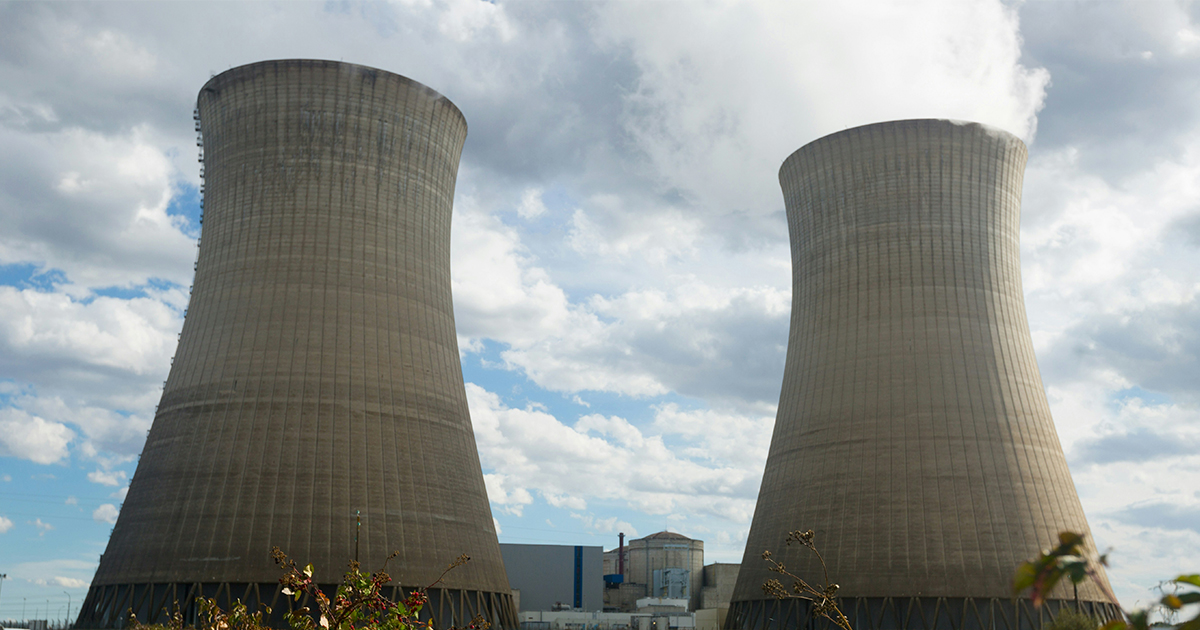
Unlike mechanical draft designs, natural draft cooling towers move air through natural convection instead of fans. These towers are best recognized by their hyperbolic shape, the iconic structure often seen at large power plants.
The hyperboloid design creates a chimney effect: as warm, moist air inside the tower rises, cooler outside air is drawn in from the base. This continuous circulation maintains airflow without any mechanical assistance. Inside, hot water flows downward across fill surfaces or tube bundles, where a portion of the water evaporates to remove heat.
Advantages:
- Extremely low operating energy since no fans or motors are used
- Minimal mechanical maintenance requirements
- Structurally efficient and capable of handling massive heat loads
Disadvantages:
- Requires substantial land area and strong foundations
- Poor adaptability to varying cooling loads
Typical Applications:
Natural draft towers are used almost exclusively in large-scale industrial settings, such as fossil fuel and nuclear power plants, where heat rejection demands are continuous and immense. In these cases, the high construction cost is justified by the extremely low long-term energy and maintenance expenses.
Open-Circuit (Wet) Cooling Towers
Open-circuit cooling towers, also known as open-loop or wet evaporative towers, are the most common type used in HVAC and industrial systems. They cool water by direct contact with air, allowing a small portion of the water to evaporate and remove heat. The cooled water collects in a basin and is recirculated.
Because heat transfer occurs through evaporation, open towers are compact, efficient, and less costly to install than closed-loop designs. However, exposure to air introduces dust, debris, and microorganisms, while evaporation concentrates minerals that can cause scaling, corrosion, or biological growth. Regular water treatment, blowdown, and make-up water are necessary. Visible vapor plumes may also appear in humid or cold weather, though drift eliminators help reduce this effect.
Advantages:
- High thermal efficiency and excellent cost-to-performance ratio
- Simpler, lower-cost construction
- Effective in most climates, especially dry environments
Disadvantages:
- High water consumption due to evaporation and blowdown
- Requires ongoing chemical treatment and cleaning
- Exposed water increases risk of scaling, corrosion, and biological growth
- Produces visible vapor plumes or drift
When Preferred:
Open-circuit towers are typically the default choice for most HVAC and industrial cooling systems when water supply is reliable and water quality can be controlled. They offer the most efficient heat rejection for the investment.
Example:
In a large commercial chiller system, warm condenser water (around 95°F) flows to an open-circuit tower, where it cools to approximately 85°F before returning to the chiller. This process allows the system to reject heat efficiently with minimal energy use. In manufacturing, the same principle can be applied to cool process water from reactors or machinery, provided the system can tolerate and manage potential contamination.
Closed-Circuit (Fluid) Cooling Towers
Closed-circuit cooling towers, also called closed-loop systems or fluid coolers, keep the process fluid isolated from outside air and water. The fluid circulates through sealed coils while an external water loop sprays over them and evaporatively cools the surface. Fans draw air through the tower to boost heat removal, but only the external water evaporates, keeping the internal fluid clean.
This design prevents fouling and contamination, making it ideal for systems requiring clean or specialized coolants such as water-glycol mixtures. Closed-circuit towers are often used in data centers, food and pharmaceutical facilities, microelectronics plants, and equipment cooling. They can also run in a dry mode during cold weather to save water and prevent freezing, though cooling capacity is reduced in that mode.
Advantages:
- Prevents contamination of the process fluid
- Reduces internal fouling and corrosion
- Lower biological risk in the process loop (less Legionella potential)
- Easier maintenance on the internal circuit
- Can operate dry in cold conditions for added flexibility
Disadvantages:
- Higher initial cost and larger size for the same capacity
- Slightly lower thermal efficiency due to the coil’s heat-transfer barrier
- Higher fan and pump energy consumption
- Coils can scale or foul externally if treatment lapses
When Preferred:
Closed-circuit towers are selected when fluid cleanliness and system protection outweigh the benefits of raw efficiency. They are particularly useful where contamination cannot be tolerated, water quality is poor, or water scarcity demands a cleaner, more controlled loop.
Example:
In a manufacturing facility, a closed-circuit tower might cool a water-glycol mixture circulating through sensitive machinery. On hot days, spray water and fans operate to provide evaporative cooling. During winter, the same tower can run dry, circulating coolant through the coils without spray water, preventing freezing and conserving water.
Hybrid Cooling Towers
Hybrid cooling towers combine wet (evaporative) and dry cooling in one system to reduce water use and visible plume while maintaining strong cooling during high temperatures or peak loads. A typical hybrid tower includes a dry section (air-cooled coils) and a wet section (evaporative). In cool or mild conditions, it can run dry or with minimal water. In hot weather, it switches to wet mode for higher performance. Some hybrid systems also reheat saturated exhaust air to reduce visible vapor plumes in cold climates.
Advantages:
- Flexible operation that saves water during mild conditions
- Reduces or eliminates visible plumes
- Helps meet regulations in water-limited or urban areas
Disadvantages:
- High cost and greater mechanical complexity
- Larger size to include both wet and dry sections
- More demanding controls and maintenance
When Used:
Hybrids are chosen only when water conservation or plume abatement is critical, such as in arid regions, urban settings, or power plants with seasonal air-quality limits. They can cut water use by 50-80 percent compared to standard wet towers but are less common due to higher capital and operating costs.
Modular Cooling Towers
Modular, or factory-assembled, cooling towers are prefabricated units that can be installed individually or combined to meet higher cooling demands. Unlike massive field-erected towers built on-site, modular units are compact, standardized, and shipped ready for quick installation. They are typically mechanical draft designs and can be open or closed-circuit.
Advantages:
- Quick installation and lower setup cost for small to medium systems
- Scalable and easy to expand as cooling demand grows
- Easier maintenance and redundancy since modules can be serviced independently
Disadvantages:
- Less efficient per unit than large custom towers
- Higher total fan power and footprint when scaled up
- More expensive per ton of cooling at very large capacities
Typical Applications:
Used widely in commercial and institutional HVAC systems such as hospitals, campuses, data centers, and factories. Modular units are ideal for projects needing fast deployment, phased expansion, or high system reliability. Large industrial plants or power stations, however, still rely on field-erected towers for greater efficiency at scale.
Comparison of Cooling Tower Types
| Type | Efficiency | Cost | Maintenance | Space | Common Uses |
| Induced Draft | High | Medium-high | Moderate | Compact | HVAC, industry |
| Forced Draft | Moderate-high | Medium | Moderate | Very compact | Indoor or low-height sites |
| Natural Draft | Moderate | Very high build, low run | Low | Very large | Power plants |
| Open-Circuit | Very high | Low build, higher water cost | High | Moderate | General HVAC, industry |
| Closed-Circuit | High | High | Moderate | Compact | Clean or critical systems |
| Hybrid | Variable | Very high | High | Large | Water-limited or plume-sensitive sites |
| Modular | High (per unit) | Scalable | Moderate | Flexible | HVAC, campuses, light industry |