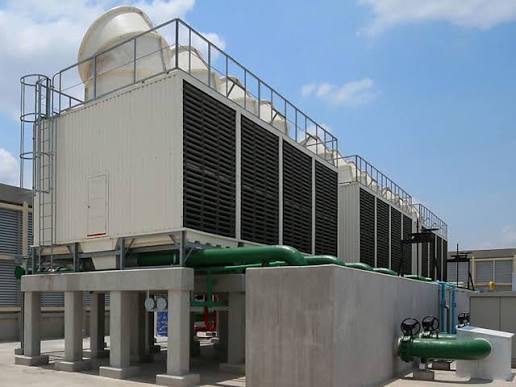
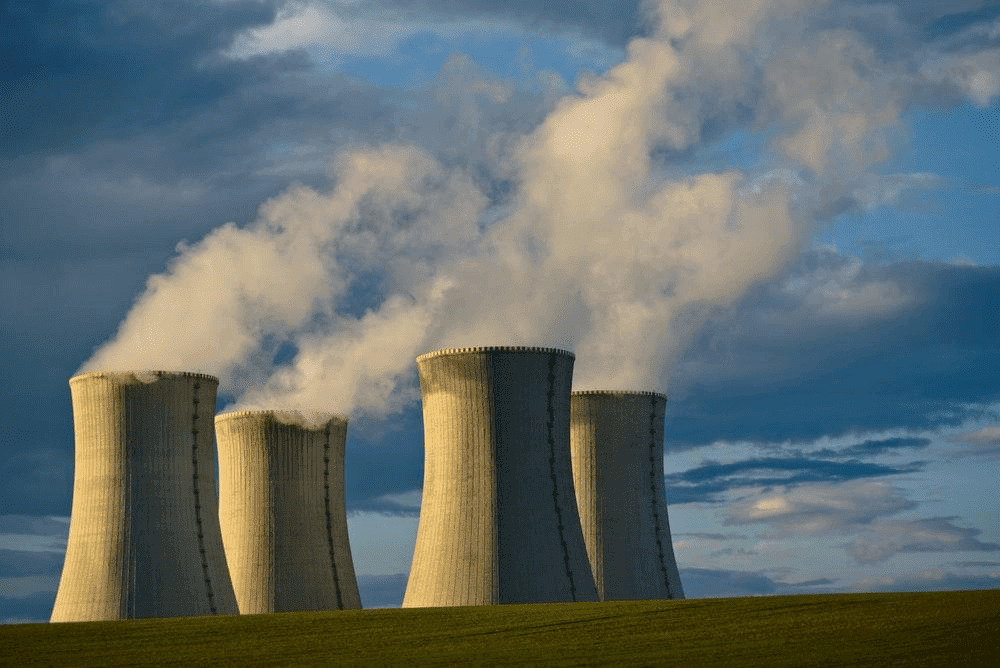
What Is a Cooling Tower?
Industrial facilities rely on cooling towers to remove excess heat from HVAC systems, manufacturing processes, and industrial equipment. By transferring unwanted heat from circulating water into the atmosphere, cooling towers help maintain safe operating temperatures, improve energy efficiency, and support reliable system performance.
Warm water from the system enters the cooling tower and is distributed over fill media to increase the surface area for heat exchange. As ambient air moves through the tower, a small portion of the water evaporates, removing heat from the remaining water. The cooled water collects in the basin and is pumped back into the system, where it absorbs more heat before repeating the cycle.
Cooling towers are widely used in commercial buildings, power plants, manufacturing facilities, chemical processing, and other industrial applications where consistent cooling is essential. Explore our complete range of Cooling Towers to find solutions designed for a variety of cooling requirements.
Main Types of Cooling Towers
Cooling towers are generally classified into two primary categories based on their cooling method:
Wet (Evaporative) Cooling Towers
Wet cooling towers rely on water evaporation to remove heat. As warm water comes into contact with moving air, a small amount evaporates, carrying heat away from the system. This makes wet cooling towers highly efficient and the preferred choice for power plants, industrial facilities, and commercial HVAC systems.
Dry Cooling Towers
Dry cooling towers use ambient air to cool the process fluid without evaporation. Since water is not exposed directly to the air, these systems significantly reduce water consumption and are commonly used in locations where water conservation is important.
How Does a Cooling Tower Work?
Cooling towers operate by combining airflow, water circulation, and evaporation to remove heat from industrial processes. The cooled water is then reused, making the system both efficient and cost-effective.
Flow of Water and Air
The cooling cycle begins when warm process water returns from industrial equipment or a chiller and enters the cooling tower. The water is evenly distributed across the fill media, increasing the contact area between water and air.
Ambient air is drawn into the tower either naturally or by mechanical fans. As air passes through the wetted fill media, it absorbs heat while a small amount of water evaporates. The cooled water then falls into the cold-water basin before being pumped back into the system. Warm, moisture-laden air exits through the top of the tower, completing the heat rejection process.
Evaporative Cooling Mechanism
The cooling process is based on the principle of evaporative cooling. As a small percentage of the circulating water changes from liquid to vapor, it absorbs heat from the remaining water. This lowers the water temperature before it is recirculated back into the cooling system.
Under normal operating conditions, the cooled water approaches the wet-bulb temperature of the entering air, making evaporative cooling one of the most effective methods of industrial heat rejection.
If you’re unfamiliar with terms such as fill media, wet-bulb temperature, or drift eliminators, visit our Cooling Tower Glossary for detailed explanations.
Types of Cooling Towers
Cooling towers are available in several configurations to meet different cooling capacities and operational requirements. For a detailed overview of each design, visit our guide on Different Types of Cooling Towers.
Based on How Air Moves
- Natural Draft: Uses the natural rise of warm, moist air to draw cooler air through the tower without mechanical fans. These towers are commonly used in large power plants.
- Mechanical Draft: Uses fans to control airflow for consistent cooling performance. Mechanical draft towers are the most common design used in industrial and commercial applications.
- Induced Draft: The fan is mounted at the outlet, pulling air upward through the fill media. This design reduces air recirculation and provides high cooling efficiency. If you are unfamiliar with terms like fill media, induced draft, or wet-bulb temperature, visit our Cooling Tower Glossary for detailed definitions.
- Forced Draft: The fan is positioned at the air inlet, pushing fresh air into the tower. While effective, it may be more susceptible to air recirculation than induced draft designs.
Many industrial facilities choose the R-LC CTI-Certified Cooling Tower to ensure verified thermal performance and dependable operation.
Based on the Direction of Airflow
- Counterflow: Air moves upward while water flows downward, maximizing heat transfer efficiency in a compact footprint.
- Crossflow: Air moves horizontally across falling water, providing easier maintenance access and quieter operation.
Based on the Type of Heat Transfer
- Open-Circuit (Wet): Water is exposed directly to air and cooled through evaporation, making this the most common and efficient cooling tower design.
- Closed-Circuit: Process fluid circulates through a sealed coil while spray water and air remove heat externally, reducing the risk of fluid contamination.
Main Components of a Cooling Tower
A cooling tower’s performance depends on several key components working together to maximize heat transfer and maintain reliable operation.
- Fill Media: Increases the contact surface between water and air, improving heat transfer and cooling efficiency.
- Water Distribution System: Evenly distributes warm water across the fill media using nozzles or distribution basins.
- Fan Assembly: Controls airflow through the tower. Mechanical draft cooling towers use either induced draft or forced draft fans to maintain consistent cooling performance.
- Drift Eliminators: Capture water droplets before they leave the tower, reducing water loss and chemical carryover.
- Cold Water Basin: Collects cooled water before it is pumped back to the condenser or industrial process for reuse.
Cooling Tower Working Diagram
The following diagram illustrates the basic cooling tower process.
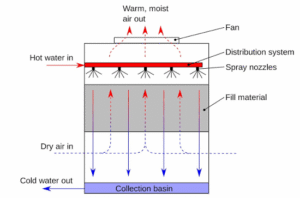
Diagram should include:
- Warm Water Inlet
- Water Distribution System
- Fill Media
- Airflow Direction
- Fan Assembly
- Heat Rejection / Evaporation
- Cold Water Basin
- Cooled Water Outlet
Cooling Tower Types Comparison
| Type | Cooling Method | Advantages | Typical Applications |
|---|---|---|---|
| Wet Cooling Tower | Evaporative cooling | High thermal efficiency | Manufacturing, HVAC, Power Plants |
| Dry Cooling Tower | Air-cooled heat exchange | Reduced water consumption | Water-restricted facilities |
| Counterflow | Air moves upward | Compact design, efficient heat transfer | Industrial facilities |
| Crossflow | Air moves horizontally | Easier maintenance, quieter operation | Commercial buildings |
| Natural Draft | Natural airflow | Low operating energy | Large power plants |
| Mechanical Draft | Fan-assisted airflow | Consistent cooling performance | Commercial and industrial systems |
Industry Applications
Cooling towers play an essential role across a wide range of industries by maintaining safe operating temperatures and improving system efficiency.
They are commonly used in:
- Manufacturing: Removes heat from production equipment and industrial machinery.
- Power Generation: Supports condenser cooling and efficient power plant operation.
- Chemical Processing: Maintains stable temperatures for reactors and process equipment.
- Food & Beverage: Helps regulate cooling during production and packaging.
- Commercial HVAC: Removes heat from chillers serving hospitals, universities, offices, and shopping centers.
Whether upgrading an existing system or selecting a new installation, choosing the right cooling tower design can improve energy efficiency, reduce operating costs, and support long-term equipment reliability.
Benefits of Cooling Towers
Cooling towers offer several advantages for commercial and industrial facilities by improving thermal efficiency and reducing operating costs. Key benefits include:
- Efficient heat rejection for consistent system performance.
- Lower energy consumption through effective water recirculation.
- Extended equipment life by preventing overheating.
- Reliable cooling for continuous industrial and HVAC operations.
- Flexible designs to accommodate a variety of facility requirements.
Routine maintenance and proper water treatment also help maximize cooling efficiency and system longevity.
Cooling Tower Maintenance Tips
Regular inspections and preventative maintenance help ensure reliable operation and reduce unexpected downtime. Best practices include:
- Inspect and clean fill media regularly.
- Monitor water quality to control scale, corrosion, and biological growth.
- Check fans, motors, and nozzles for proper operation.
- Remove debris from the cold-water basin.
- Follow the manufacturer’s recommended maintenance schedule.
Proper maintenance improves thermal performance while extending the lifespan of your cooling tower.
Frequently Asked Questions
What is the purpose of a cooling tower?
A cooling tower removes excess heat from industrial processes or HVAC systems by transferring it from circulating water into the atmosphere.
What is the difference between wet and dry cooling towers?
Wet cooling towers use evaporation to cool water, while dry cooling towers use ambient air without direct water evaporation, making them suitable for areas where water conservation is important.
Which industries use cooling towers?
Cooling towers are commonly used in manufacturing, power generation, chemical processing, food and beverage production, data centers, and commercial HVAC systems.
Where can I learn more about cooling tower terminology?
Visit our Cooling Tower Glossary to explore commonly used cooling tower terms and definitions.
Where can I find industrial cooling tower solutions?
CTS offers a complete range of Cooling Towers engineered for commercial and industrial applications. Facilities seeking independently verified thermal performance can also explore the R-LC CTI-Certified Cooling Tower.