
Cooling tower motors run in one of the hardest environments any electric motor faces. Constant moisture. Warm, humid air pulled directly past the housing by the fan they drive. Long duty cycles, often continuous through the cooling season. Outdoor temperature swings, and in many installations, direct sun and freezing weather within the same year.
They are a wear item, and eventually they fail. This page covers how to recognise a motor going bad, what to rule out before you replace it, how to specify the right replacement, and how to order one.
Signs your motor is failing
Higher current draw
The most reliable early warning, and the reason an annual amp reading is worth the five minutes it takes. If the motor is pulling more current than its nameplate rating at the same load, something is wrong — worn bearings adding drag, winding degradation, or a fan pitch problem loading the motor past its design point. Rising amp draw gives you months of warning before a failure that would otherwise be a surprise.
Tripping the overload
Repeated overload trips are a symptom, not the problem. Something is causing the motor to draw more current than it should, and resetting the overload without finding out what simply delays the failure. Common causes are bearing wear, voltage imbalance, a fan obstruction, and a motor that is simply at the end of its life.
Humming without rotation
The motor is energised but the shaft is not turning. On three-phase motors this usually means a lost phase — check voltage at all three terminals. It can also be a seized bearing, or on single-phase units, a failed start capacitor. Do not leave a humming motor energised; it will overheat quickly.
Bearing noise
Grinding, rumbling, or a rising squeal from the motor housing. Bearings are the most common mechanical failure point in cooling tower motors, largely because moisture finds its way past the seals over time. Bearings almost always give audible warning before they seize.
Excessive heat
Motors run warm in normal operation. A motor too hot to keep a hand on briefly is running too hot, and sustained heat is what destroys winding insulation. Overheating points to overload, voltage problems, blocked cooling airflow around the housing, or failing bearings.
Vibration
New or worsening vibration can originate in the motor, but check the fan first. An unbalanced or damaged fan blade transmits vibration straight into the motor bearings and will destroy them. Fixing the motor without fixing the fan means doing it again.
Moisture or corrosion inside the housing
Water ingress is a leading cause of cooling tower motor failure. If you find moisture, rust, or corrosion inside the junction box or housing, the motor is on borrowed time even if it is still running.
Check these before replacing the motor
Motors get replaced that did not need replacing. Before you order, rule these out:
Power supply
Verify voltage at the motor terminals on all three phases under load. Voltage imbalance between phases causes disproportionate current imbalance, which causes overheating and premature failure. A small voltage imbalance produces a much larger current imbalance — this is a common and frequently missed cause of repeat motor failures.
The overload and starter
A failing contactor or a mis-sized overload can mimic motor failure exactly. Check the contacts for pitting and confirm the overload is rated correctly for the motor.
Wiring and connections
Corrosion at terminal connections inside the junction box is common in this environment and creates resistance, heat, and voltage drop. Open the box and look.
Fan condition
A damaged, unbalanced, or incorrectly pitched fan overloads the motor continuously. Check blade condition, confirm all blades are set to the same pitch, and look for debris or ice buildup.
Free rotation
With power isolated and locked out, turn the fan by hand. It should rotate smoothly with minimal resistance. Grinding, catching, or noticeable drag points to bearings in the motor or the fan shaft.
Direct drive and belt drive
[CONFIRM WITH CTS which models use which before publishing this section.]
How to tell which you have
Direct drive — the fan mounts directly onto the motor shaft. Nothing sits between the motor and the fan. Fewer wear parts, less routine maintenance, and no belt to fail. The trade-off is that fan speed is fixed by motor speed.
Belt drive — the motor sits to one side and drives the fan through a belt and two sheaves. You will see the belt and pulleys clearly. Belt drive allows fan speed to be adjusted by changing sheave sizes, but adds components that wear.
Belt drive wear points
If your tower is belt driven, these need attention that a direct drive tower does not:
- Belt slip — squealing on startup, or the fan visibly turning slower than expected. Slipping belts also mean reduced airflow and reduced cooling.
- Glazing — a shiny, hardened belt surface. Glazed belts have been slipping and will not grip properly again; replace rather than retension.
- Cracking or fraying — replace before it breaks. A belt failure takes the tower offline instantly.
- Sheave wear — grooves worn deep, or with a polished bottom, will not grip a new belt. Replacing a belt into worn sheaves wastes the belt.
- Misalignment — causes rapid belt wear and side-loads the motor bearings. Check with a straightedge across both sheave faces.
- Tension — too loose slips, too tight destroys bearings. Follow the manufacturer's deflection specification.
Why cooling tower motors are different
A general purpose motor will not last in cooling tower service. Replacements need to be specified for this duty specifically:
- TEFC enclosure — totally enclosed, fan cooled, to keep moisture away from the windings
- Moisture-resistant insulation rated for continuous humid service
- Corrosion-resistant hardware — shaft, fasteners, and housing finish
- Correct pole count — this determines fan speed, and fan speed determines airflow
- Suitable mounting configuration — cooling tower motors are often vertically mounted, which affects bearing and seal requirements
Pole count matters more than most people expect. An 8-pole and a 6-pole motor of identical horsepower run at different speeds and will not produce the same airflow through the same fan. Matching horsepower alone is not enough — a tower fitted with the wrong pole count will either underperform or overload the motor.
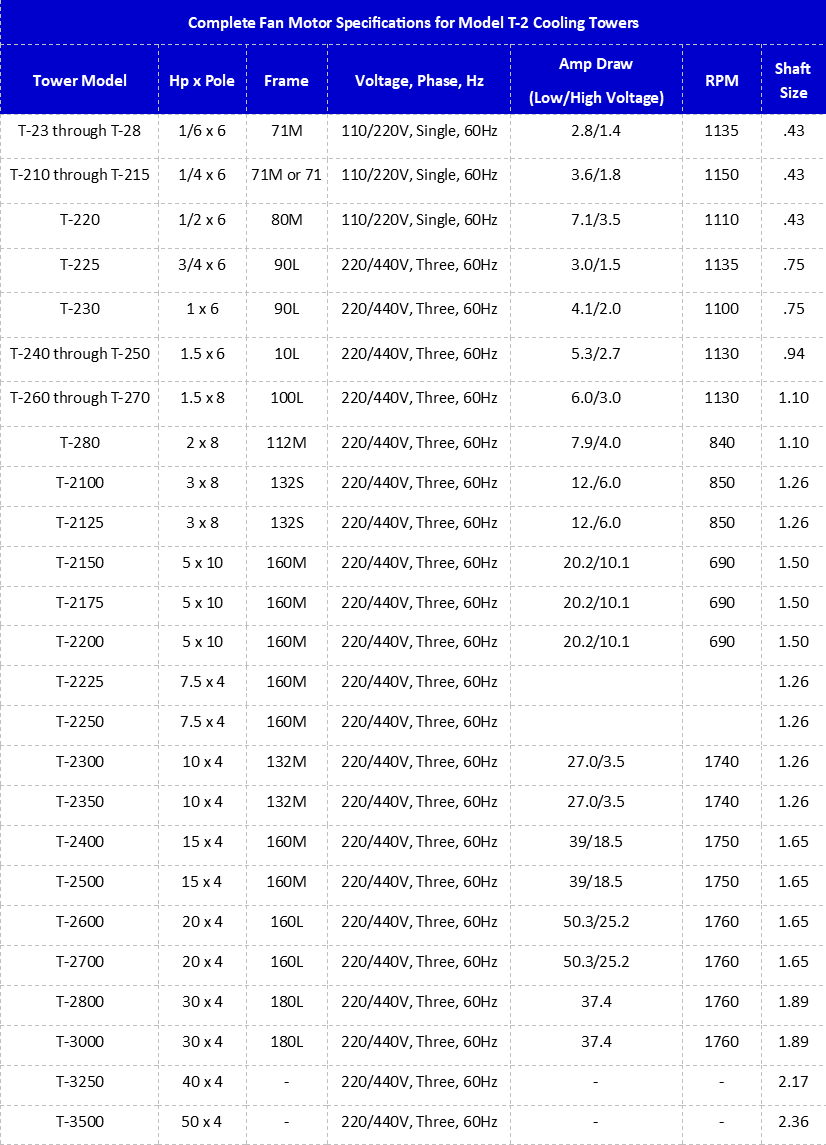
CTS motor specifications by model
Motors across the T-2 line are 208-230/460V, three phase, 60 Hz unless specified otherwise.
| Model | Nominal Tons | Fan Motor |
|---|---|---|
| T-250 | 50 | 1.5 HP, 6-pole |
| T-260 | 60 | 1.5 HP, 8-pole |
| T-280 | 80 | 2 HP |
[CONFIRM WITH CTS: complete this table for all 30 models before publishing. Data is in the Engineering Brochure.]
NEMA frame drawings
Dimensional drawings by horsepower, for confirming fit before you order:
- 3/4 HP
- 1 HP
- 1.5 HP, 6-pole
- 1.5 HP, 8-pole
- 2 HP
- 3 HP
- 5 HP
- 7.5 HP, 6-pole
- 10 HP, 4-pole
- 15 HP, 6-pole
- 20 HP, 4-pole
- 30 HP, 6-pole
- 40 HP, 4-pole
- 50 HP, 6-pole
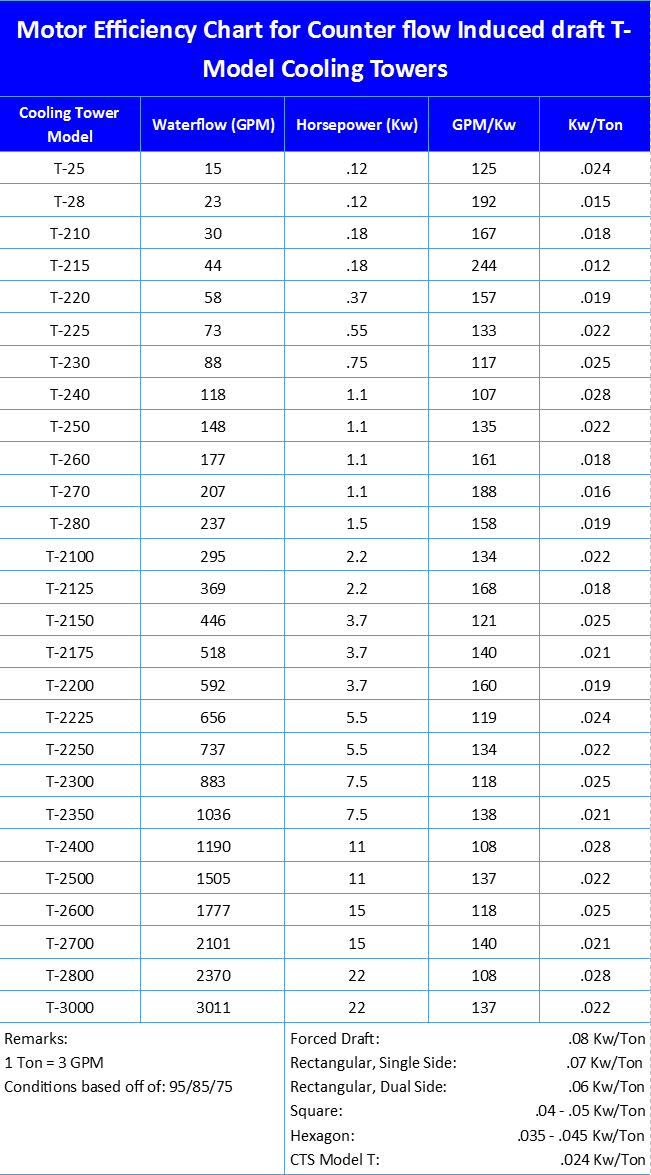
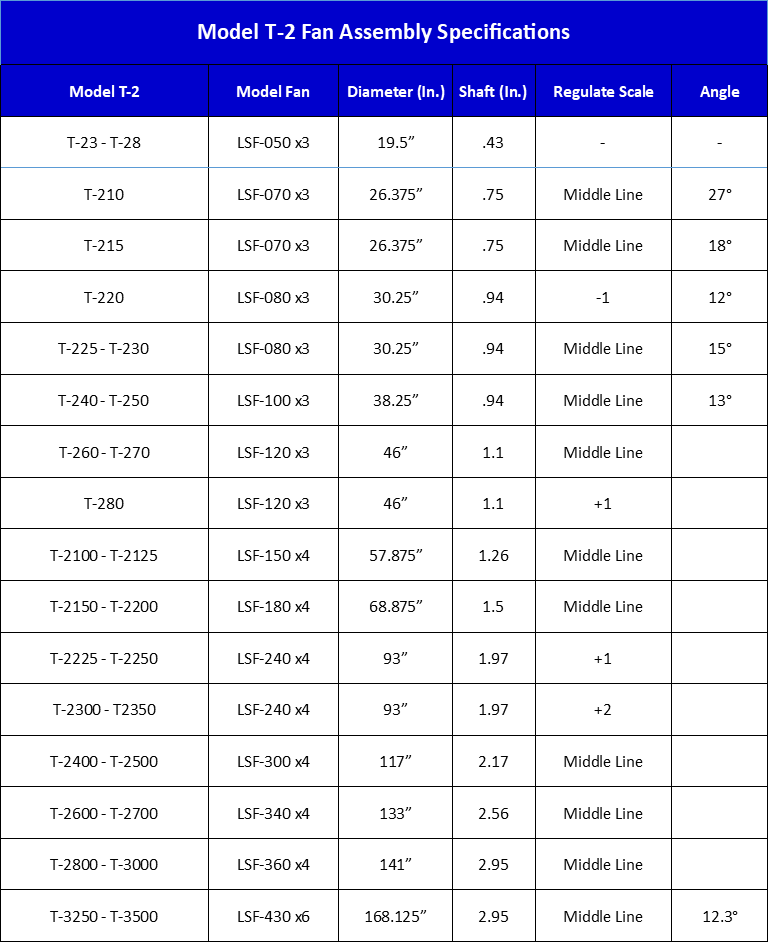
Also useful: the motor specification chart, the motor efficiency chart, and the fan assembly pitch chart.
How to order a replacement motor
The fastest route is to send us a photo of the motor nameplate.
The nameplate carries horsepower, voltage, phase, RPM, frame size, service factor and enclosure type — everything needed to match a replacement exactly, with no guesswork. A phone photo is fine as long as the text is legible.
If the nameplate is corroded or painted over, send us your cooling tower model number instead and we will look up the original specification from our records.
Tell us at the same time whether anything about the installation has changed — different voltage supply, a variable frequency drive added, or a change in operating hours. Those affect what we recommend.
Send us a nameplate photo or call 800-752-1905.
Replace the motor, or the tower?
A motor on its own is almost always worth replacing. It is a defined cost against a tower that otherwise works.
The calculation changes when the motor has failed alongside other things. If you are also looking at worn fill, degraded drift eliminators, and a basin that is starting to corrode, the combined parts cost can approach the price of a new tower — and you would be spending it on a structure that is already decades old.
Work through our inspection and troubleshooting guide to see the whole picture before you order, or call us and we will talk it through honestly.
Frequently asked questions
Can I fit a higher horsepower motor for more airflow?
Not without changing the fan. Airflow is set by fan diameter, pitch and speed, not by motor horsepower. A larger motor on the same fan simply draws more current than necessary. If you need more capacity, the answer is usually a larger tower — check your sizing.
Can I use a VFD on a cooling tower motor?
Often yes, and it can cut energy consumption significantly during part-load operation. The motor has to be inverter-duty rated, and there are minimum speed considerations to avoid fan resonance. Talk to us before fitting one to an existing motor.
Why does my motor keep failing?
Repeat failures almost always have an external cause. The usual suspects are voltage imbalance, moisture ingress, an unbalanced fan, or an incorrectly sized overload. Replacing the motor again without finding the cause will produce the same result.
How long should a cooling tower motor last?
It varies widely with duty cycle, environment, and maintenance. A well-specified, properly protected motor with sound bearings and clean power lasts considerably longer than one running with voltage imbalance or a vibrating fan.
Order a motor
Request a parts quote or call 800-752-1905.
Browse the replacement parts catalog or find parts for your specific model on the parts hub.