
Cooling Towers for Hospitals & Large Facilities
Engineered for the continuous-duty cooling demands of hospitals, medical centers, universities, and large institutional facilities where uptime is non-negotiable.
The Challenge
The cooling challenge in hospitals and large facilities
Hospitals and large institutional facilities operate under one of the strictest reliability standards in the built environment. Operating rooms, ICUs, imaging suites, pharmacy environments, and patient-care areas all depend on precise, continuous environmental control. When cooling fails, the consequences extend beyond comfort to patient safety, regulatory compliance, and equipment damage.
Cooling towers sit at the center of the heat-rejection chain that makes the entire HVAC system possible. Hospitals and large facilities face cooling requirements unlike any other commercial environment:
24/7/365 continuous operation
No scheduled downtime windows.
Redundancy requirements
N+1 or N+2 configurations to eliminate single points of failure.
Strict water quality
Including Legionella risk-management protocols.
Code compliance
ASHRAE 188, state and local water-management regulations.
Quiet operation
Patient-care, residential, or noise-sensitive areas nearby.
Long service life
Institutions plan around 25–30+ year horizons.
Energy efficiency
Cooling is a major share of facility operating cost.
System Architecture
How cooling towers fit into hospital & large-facility cooling
The chiller plant transfers heat from air handlers, process cooling, and equipment loads to the condenser water loop, which is sent to the cooling tower for evaporative heat rejection.
→
Air handlers
→
Chilled water
→
Chiller
→
Condenser water
→
Cooling tower
Common configurations
- Open-loop cooling towers paired with centrifugal or absorption chillers serving central plants
- Closed-loop fluid coolers for process applications requiring isolation between system and ambient water
- Multi-cell redundant configurations supporting N+1 or N+2 reliability strategies
- Waterside economization allowing free cooling when ambient wet-bulb temperatures permit
CTS works with consulting engineers, facility planners, and mechanical contractors to size and specify cooling towers that meet the redundancy, code compliance, and lifecycle requirements of institutional projects. We bring the same approach to other mission-critical environments, including data centers with similar uptime and redundancy demands.
Why FRP
Why FRP cooling towers are right for hospitals and large facilities
Corrosion resistance
Hospitals run aggressive water-treatment programs to manage Legionella, scale, and biological growth — chemistries that punish galvanized steel. FRP is non-corrosive by design: it doesn’t rust, scale, or degrade, eliminating one of the leading causes of premature tower failure in institutional facilities.
Long service life for long-horizon facilities
Institutional facilities are built and operated on long timelines. FRP towers routinely deliver 20–30+ years of service vs. 10–15 for galvanized steel — backed by a 20-year warranty that aligns with real lifecycle-planning horizons. For facilities evaluating an aging tower, our replacement and retrofit guide is a practical starting point.
Designed for easier maintenance
FRP won’t rust or deteriorate over time. Corrosion-resistant surfaces help maintain cleaner equipment conditions and simplify routine inspection — supporting more consistent performance for facilities running ASHRAE 188 water-management programs.
Continuous-duty reliability
A cooling tower failure in a hospital isn’t a maintenance issue — it’s a patient-safety issue. FRP towers are engineered for continuous-duty operation with proven performance in critical-care environments. There is a reason why institutional engineers keep specifying Cooling Tower Systems, and it is worth understanding.
Quiet operation
Lower fan tip speeds and optional low-noise packages help institutional facilities meet noise constraints near patient-care areas, residential zones, or shared campuses.
Energy efficiency
The CTS T-2 counterflow induced-draft design reduces fan horsepower per ton. Lower kWh consumption translates directly into lower utility costs across a 24/7/365 operating profile. For large facilities running continuous loads, the long-term savings on cooling are substantial.
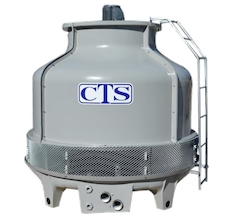
The CTS T-2 Counterflow Cooling Tower
Flagship Tower
Specified into hospitals and institutions nationwide
The T-2 is our flagship counterflow induced draft cooling tower, specified into hospitals, medical centers, universities, and large institutional facilities across the country.
Standard features
- Fiberglass reinforced polyester (FRP) shell and structural components
- Counterflow induced draft design for maximum thermal efficiency
- High-efficiency PVC fill media
- Pressurized water distribution system
- Stainless steel hardware
- Drift eliminators with industry-leading efficiency
Optional features
- Low-noise fan packages for noise-sensitive sites
- Redundant cell configurations (N+1 / N+2)
- Custom sizing per facility heat load
- Cold-water basin — CTS uses non-corrosive FRP, so a stainless-steel basin isn’t required.
- Vibration switches & capacity controls — available, though CTS fans are balanced and tested before installation, so vibration isn’t a concern.
Comparison
FRP vs. galvanized steel for hospital & institutional cooling
| Factor | FRP (CTS) | Galvanized steel |
|---|---|---|
| Corrosion resistance | Excellent — non-corrosive by design | Moderate — degrades in aggressive water |
| Service life | 20–30+ years | 10–15 years typical |
| Maintenance | Minimal | Routine rust treatment and recoating |
| Cleanability | Smooth surface, lower biofilm risk | Rougher surface, harder to clean |
| Legionella management compatibility | Excellent | Adequate but more challenging |
| Lifecycle cost | Lower | Higher |
For hospitals and institutions with long-term operating horizons, FRP delivers a measurable total cost of ownership advantage.
Applications
Hospital & large-facility applications we serve
- Hospitals & medical centers
- Surgical & ambulatory care
- Imaging & diagnostic centers
- Long-term care facilities
- Universities & colleges
- K-12 school districts
- Government & military
- Convention centers & arenas
- Corporate campuses
- Airports & transportation
- Correctional facilities
- Research laboratories
Engineering Support
Custom sizing, concept through commissioning
Every institutional facility has a different cooling profile. Building size, patient census, equipment load, redundancy strategy, and climate all factor into the right specification. Our in-house team supports your project end to end.
- Heat load and thermal performance evaluations using your facility’s design data
- Custom sizing and redundant cell configuration
- Formal quotations with technical specifications and drawings
- CAD drawings, cut sheets, and O&M manuals
- Replacement parts for every system we build
FAQ
Frequently asked questions
How do I size a cooling tower for my hospital or institutional facility?
Sizing depends on the facility’s total cooling load (typically in tons), the design wet-bulb temperature for the site, the desired water temperature drop, and the redundancy strategy required by code and facility standards. CTS engineers run thermal performance calculations using your design data and recommend the right capacity and cell configuration.
How do CTS cooling towers support Legionella risk management?
FRP construction provides a smooth, non-corrosive surface that’s easier to clean and less prone to biofilm than galvanized steel. The T-2 serves the condenser/process-water side and is compatible with the water-treatment, monitoring, and management protocols required under ASHRAE 188 and most state and local water-management codes.
What redundancy configurations does CTS support?
CTS supports N+1, N+2, and 2N redundancy strategies through multi-cell configurations. Our engineering team specifies the right cell count and capacity per cell to match your facility’s reliability standards and load profile.
Do CTS cooling towers meet ASHRAE thermal and water-management standards?
Yes. CTS cooling towers are designed to support the thermal performance and water-management requirements common in hospital and institutional projects, including ASHRAE 188 compatibility.
Can CTS cooling towers operate in noise-sensitive environments near patient-care areas?
Yes. Low-noise fan packages and lower fan tip speeds let CTS cooling towers meet the strict noise constraints common to hospital and campus installations.
What is the expected service life of a CTS FRP cooling tower in an institutional environment?
With proper water treatment and routine maintenance, CTS warrants 20 years on the FRP (fiberglass) casing and cold-water basins, 2 years on all PVC fill, and 1 year on all fan motors, major drive components, and internal moving parts — even under continuous-duty operation.
Can I replace an existing galvanized cooling tower with FRP without major infrastructure changes?
In most cases, yes. CTS provides replacement towers sized to match existing footprints, basin dimensions, and piping connections. Our engineering team reviews your existing installation and recommends a drop-in or modified replacement.
What is the typical lead time for a CTS cooling tower?
Lead times vary by configuration and project complexity. Standard configurations typically ship within several weeks of order; larger or custom configurations may take longer. Contact us with your timeline and we’ll provide a firm delivery schedule with your quote.
Comparison
Request a quote for your hospital or institutional cooling tower
Whether you’re building a new facility, planning a capital replacement, or expanding an existing campus, our engineering team is ready to spec the right cooling tower for your operation.
In-house engineering · Manufactured in Macon, GA