
Cooling Towers for Manufacturing & Injection Molding
Engineered for the process cooling demands of manufacturing plants, injection molding operations, and production environments running continuous-duty cycles.
The Challenge
The cooling challenge in manufacturing and injection molding
Process cooling drives production throughput. In manufacturing and injection molding, cooling capacity directly determines cycle time, output quality, and equipment longevity. When the cooling system underperforms, mold cycle times stretch, machines run hotter, and production targets slip.
Injection molders feel it most acutely — mold cooling is typically 60–80% of total cycle time. A system that can’t pull heat out of the mold fast enough costs real money on every part. Manufacturing operations share a common set of cooling requirements:
Continuous-duty cooling
For 24/7 production runs.
Tight water temperature control
Consistent mold temperatures and product quality.
High heat rejection capacity
For hydraulic systems, mold cooling, and process equipment.
Aggressive water chemistry
Process treatment programs are hard on tower materials.
Energy efficiency
Utility costs are a significant operating expense.
Reliability
Unplanned cooling downtime means lost production.
System Architecture
How cooling towers fit into manufacturing & molding cooling
In a typical manufacturing or molding facility, cooling towers reject heat from a central process water loop or chiller plant that feeds the production floor.
→
Process water loop
→
Chiller
→
Cooling tower
Common applications
- Injection molding machine cooling — hydraulic oil coolers, barrel feed throats, and mold circuits
- Mold temperature control through chilled water loops for consistent cycle times
- Hydraulic system cooling for presses, stamping, and forming equipment
- Compressor and pump cooling for plant air and process systems
- Welding equipment cooling for resistance and induction welding
- Process equipment cooling — extruders, blow molders, and thermoformers
- Plant HVAC condenser water for facility environmental control
CTS works with plant engineers, mechanical contractors, and facility designers to size cooling capacity that matches process load, expansion plans, and seasonal demand. We also partner with HVAC contractors who handle cooling system design and installation for manufacturing clients.
Why FRP
Why FRP cooling towers are right for manufacturing and injection molding
Corrosion resistance
Manufacturing runs aggressive water chemistries — mineral content, treatment chemicals, biocides, and pH variability — that destroy galvanized steel over time. FRP is non-corrosive by design: it doesn’t rust, scale, or degrade, eliminating one of the most common causes of premature tower failure.
Continuous-duty reliability
Unplanned downtime is expensive. When mold temperatures drift, cycle times stretch and scrap rates climb. If an aging tower is contributing to that problem, it may be time to work through the repair vs. replacement decision. FRP towers are engineered for continuous duty with a service life matched to a 24/7 production facility.
Faster cycle times through consistent cooling
Stable, consistent process water temperatures help injection molders hit shorter, more predictable cycle times. The CTS T-2 counterflow design delivers reliable thermal performance even under varying load.
Energy efficiency
The CTS T-2 counterflow induced-draft design reduces fan horsepower per ton. Lower kWh consumption translates directly into lower utility costs on every part produced. Across a full production year, those reductions have a measurable impact on overall cooling tower ROI.
Scalable for facility expansion
Manufacturers routinely add presses, lines, and capacity. CTS supports multi-cell configurations that let operators add cooling in phases without overbuilding upfront.
Lower total cost of ownership
FRP towers routinely deliver 20–30+ years of service vs. 10–15 for galvanized steel. CTS is the only manufacturer to back its towers with a 20-year warranty — lower maintenance, no recoating, no rust mitigation. There is more behind that commitment, and it is worth knowing what sets Cooling Tower Systems apart.
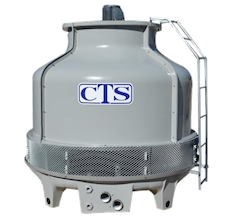
The CTS T-2
Flagship Tower
The CTS T-2 Counterflow Cooling Tower
The T-2 is our flagship counterflow induced draft cooling tower, specified into manufacturing plants and injection molding operations across the U.S. and internationally.
Standard features
- Fiberglass reinforced polyester (FRP) shell and structural components
- Counterflow induced draft design for maximum thermal efficiency
- High-efficiency PVC fill media
- Pressurized water distribution system
- Stainless steel hardware
- Drift eliminators with industry-leading efficiency
Optional features
- Low-noise fan packages for noise-sensitive sites
- Multi-cell configurations for phased expansion
- Custom sizing per facility heat load
- Cold-water basin — CTS uses non-corrosive FRP, so a stainless-steel basin isn’t required.
- Vibration switches & capacity controls — available, though CTS fans are balanced and tested before installation, so vibration isn’t a concern.
Comparison
FRP vs. galvanized steel for manufacturing cooling
| Factor | FRP (CTS) | Galvanized steel |
|---|---|---|
| Corrosion resistance | Excellent — non-corrosive by design | Moderate — degrades in aggressive water |
| Service life | 20–30+ years | 10–15 years typical |
| Maintenance | Minimal | Routine rust treatment and recoating |
| Water chemistry compatibility | Compatible with most process water | Sensitive to pH and mineral content |
| Downtime risk | Low | Higher — rust and scale cause failures |
| Lifecycle cost | Lower | Higher |
For continuous-duty production facilities, FRP delivers a clear total cost of ownership advantage.
Applications
Manufacturing applications we serve
- Injection molding
- Blow molding
- Extrusion & thermoforming
- Plastics manufacturing
- Stamping & forming
- Die casting
- Welding operations
- Machine shops & CNC
- Rubber & elastomer production
- Industrial & process manufacturing
- Automotive parts production
- Consumer goods manufacturing
Engineering Support
Custom sizing, design through operation
Every facility has a different cooling profile. Number of presses, mold types, hydraulic load, ancillary equipment, and seasonal climate all factor into the right specification. Our in-house team supports your project end to end.
- Heat load and thermal performance evaluations using your facility’s operating data
- Custom sizing and multi-cell configuration
- Formal quotations with technical specifications and drawings
- CAD drawings, cut sheets, and O&M manuals
- Replacement parts for every system we build
FAQ
Frequently asked questions
How do I size a cooling tower for my injection molding operation?
Sizing depends on the total heat load from your presses (hydraulic and mold cooling), ancillary equipment, and process loads, plus the design wet-bulb temperature for your location and the water temperature drop your chiller plant requires. As a starting point, injection molding presses typically require 0.5–1 ton of cooling per machine horsepower, though actual sizing varies by mold and material. CTS engineers run a thermal performance calculation using your specific operating data — entering water temperature, desired leaving water temperature, and installation location.
How does cooling tower performance affect injection molding cycle times?
Significantly. Mold cooling is typically 60–80% of total cycle time. Consistent, reliable cold-water supply allows shorter, more predictable cycles. An undersized or underperforming tower forces molders to extend cycles or run mold temperatures higher than ideal — both reduce throughput and can affect part quality.
Can FRP cooling towers handle the water chemistry in manufacturing facilities?
Yes. FRP is non-corrosive and chemically compatible with most water-treatment chemistries, including the aggressive treatment programs common in industrial process water — one of the clearest advantages over galvanized steel in manufacturing applications.
Can CTS cooling towers scale with production expansion?
Yes. Multi-cell configurations let operators phase in cooling capacity as production capacity expands, and we can plan an initial installation with future expansion in mind.
Are CTS cooling towers compatible with closed-loop and glycol systems?
Yes. CTS supplies closed-loop fluid coolers and cooling towers compatible with glycol and other closed-loop architectures common in process cooling.
What is the expected service life of a CTS FRP cooling tower in a manufacturing environment?
With proper water treatment and routine maintenance, CTS warrants 20 years on the FRP (fiberglass) casing and cold-water basins, 2 years on all PVC fill, and 1 year on all fan motors, major drive components, and internal moving parts — even under continuous-duty operation.
Can I replace an existing galvanized cooling tower with FRP without major infrastructure changes?
In most cases, yes. CTS provides replacement towers sized to match existing footprints, basin dimensions, and piping connections. Our engineering team reviews your existing installation and recommends a drop-in or modified replacement.
What is the typical lead time for a CTS cooling tower?
Lead times vary by configuration. Standard configurations typically ship within several weeks of order; custom or larger configurations may take longer. Contact us with your timeline and we’ll provide a firm delivery schedule with your quote.
Comparison
Request a quote for your manufacturing or injection molding cooling tower
Whether you’re building a new facility, expanding existing capacity, or replacing aging cooling equipment, our engineering team is ready to spec the right cooling tower for your operation.
In-house engineering · Manufactured in Macon, GA