
Cooling Tower Replacement and Retrofit Guide: Making the Right Call
When performance slips, maintenance costs climb, or a major component fails, here is how to decide whether your cooling tower is worth fixing, worth upgrading, or ready for replacement.
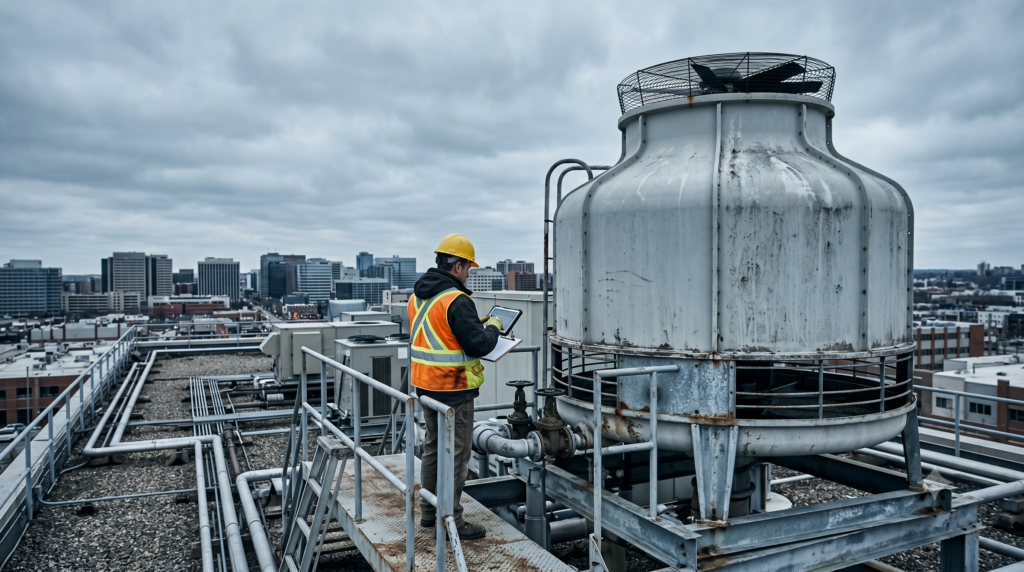
At some point, every cooling tower reaches a crossroads. Performance has slipped, maintenance costs are climbing, or a major component has failed — and the question shifts from "what does it need?" to "is it worth fixing?"
This guide walks through the factors that determine whether a cooling tower should be repaired, retrofitted, or replaced — and gives you a practical framework for making that call with confidence.Understanding the options
Repair
A targeted fix of a specific failed component — a motor, gearbox, basin patch, or worn fill media. Repair makes sense when the problem is isolated and the rest of the system is in good condition.Retrofit
A broader upgrade to an existing tower that improves performance or extends life — new fill, fan assembly, distribution system, or mechanical drive — while retaining the basin and structure.Full replacement
Complete removal and installation of a new system. The right call when the structure is compromised, the tower is at end of life, or retrofit cost approaches the cost of new.The 30 percent rule
A widely used benchmark in industrial equipment management:30%
Once repair or retrofit costs pass 30% of a new tower's installed price, full replacement deserves serious consideration.
Past 50%, replacement is almost always the better long-term decision. Running the numbers on replacement vs. repair is easier than most expect, and the long-term savings often make the decision clear.
Which path is right for you?
Signs a retrofit may be right
- Basin and structural frame are in good condition, but mechanical components are worn
- Fill media is fouled or damaged, but the distribution system and casing are serviceable
- The existing footprint and connections make a like-for-like replacement difficult or costly
- The system is 10–18 years old with documented maintenance and no structural issues
- Retrofit cost is under 30% of new system cost
Signs full replacement is right
- Basin corrosion, cracking, or significant structural deterioration
- Widespread casing damage across multiple panels
- Recurring failures on multiple components in a short period
- System is over 20 years old with a deferred-maintenance history
- Thermal performance well below rated capacity even after fill replacement
- Retrofit cost exceeds 30–40% of new system cost
- Capacity or load requirements have changed significantly since installation. This is especially common in manufacturing environments where process loads grow over time.
The replacement sizing opportunity
If replacement is the right call, resist the temptation to simply swap like-for-like. Use it as an opportunity to:- Right-size the system to your current load and anticipated growth
- Upgrade to materials better suited to your water chemistry and environment
- Reconsider whether your configuration (counterflow vs. crossflow, induced vs. forced draft) is still optimal
How CTS Can Help
Our team works with facility managers and engineers through this decision every day. We also work closely with HVAC contractors who manage these evaluations on behalf of their clients. We can review your current system condition, help you model the retrofit vs. replace economics, and specify the right replacement if that is the path that makes sense. We also stock parts for every tower we manufacture, so if repair or retrofit is the right answer, we can support that too. Call us at 800-752-1905 or contact us online to discuss your situation.Need Help Finding the Right Part?
Need help finding the right cooling tower part? Our team can help identify your tower model, confirm compatible replacement components, and answer any technical questions so you get the correct part the first time.