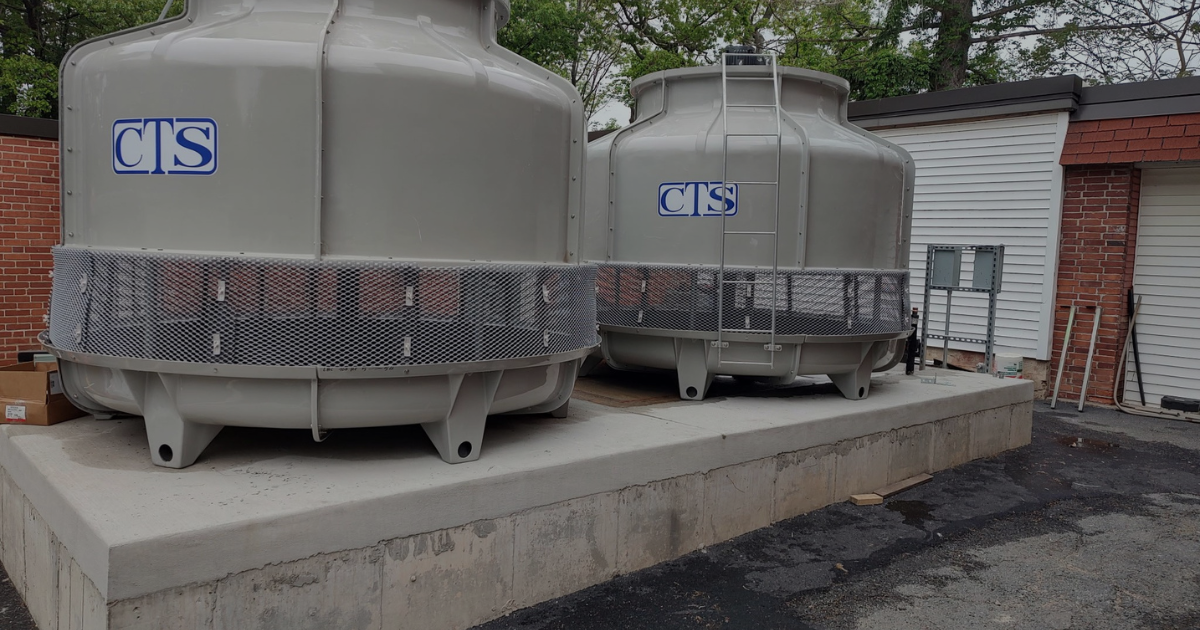
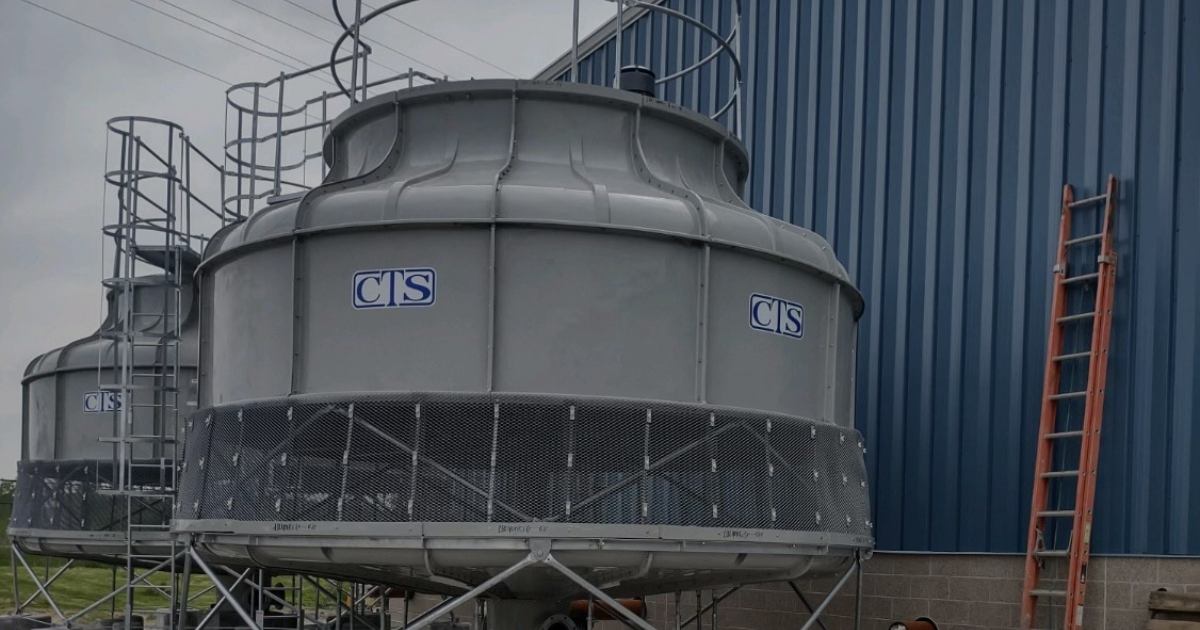
Industrial facilities rely on industrial cooling towers to remove excess heat from HVAC systems, manufacturing processes, and industrial equipment. Warm water from the system is pumped into the tower, where it is distributed over fill material to increase the surface area for heat exchange. Air is drawn or forced through the tower, allowing some of the water to evaporate, which cools the remaining water. The cooled water is then recirculated back to absorb more heat.
There are two main types of cooling towers:
- Wet (evaporative) cooling towers: These rely on water evaporation for cooling. They are common in power plants and HVAC systems.
- Dry cooling towers: These use air alone to cool the fluid, without evaporation, and are used where water conservation is important.
Essentially, a cooling tower helps maintain thermal efficiency in large-scale systems by keeping water at manageable temperatures.
How Does a Cooling Tower Work?
To better understand how cooling towers work, it’s important to understand the relationship between airflow, evaporation, and heat transfer.
Flow of Water and Air
- Warm process water returns from the chiller or equipment and enters the cooling tower.
- The water is sprayed or distributed across fill media to maximize its contact area and contact time with air.
- Ambient air is drawn in by fans or induced naturally through the tower and passes through the wetted fill.
- As air and water mix, the air picks up heat and some moisture by evaporation.
- Cooled water falls to the cold-water basin.
- The system pump sends this cooled water back to the process or chiller for reuse.
- Warm, moisture-laden air exits the tower to the atmosphere.
Evaporative Cooling Mechanism
- A portion of the circulating water evaporates into the air stream.
- The phase change from liquid to vapor absorbs heat (latent heat of vaporization) from the remaining water.
- The remaining water cools, approaching the wet-bulb temperature of the entering air.
- The cooled water then collects in the basin and is recirculated back into the system.
Types of Cooling Towers
There are several different types of cooling towers, each designed for specific cooling requirements, environmental conditions, and facility layouts.
Based on How Air Moves
- Natural Draft: Uses the natural rise of warm, moist air to draw cooler air through the tower without any fans. Common in large power plants with tall hyperbolic structures that rely on the chimney effect.
- Mechanical Draft: Uses fans to control airflow and maintain consistent cooling. More compact and versatile than natural draft systems.
- Induced Draft: The fan is mounted at the outlet, pulling air upward through the fill. This design prevents recirculation and offers high efficiency with relatively low noise. If you are unfamiliar with terms like fill media, induced draft, or wet-bulb temperature, visit our cooling tower glossary for detailed definitions.
- Forced Draft: The fan is positioned at the inlet, pushing air into the tower. It provides good air control but can be less efficient due to potential recirculation.
Many industrial facilities choose CTI-certified cooling towers to ensure verified thermal performance and operational reliability.
Based on the Direction of Airflow
- Counterflow: Air travels upward while water falls downward, creating a direct, opposing flow that improves heat transfer efficiency. Compact design, ideal where space is limited.
- Crossflow: Air moves horizontally across the falling water. Easier to service, with lower air resistance and quieter operation, though slightly less thermally efficient than counterflow designs.
Based on the Type of Heat Transfer
- Open-Circuit (Wet): Water is exposed directly to air, and cooling occurs through evaporation. Simple, efficient, and widely used, though it requires water treatment a