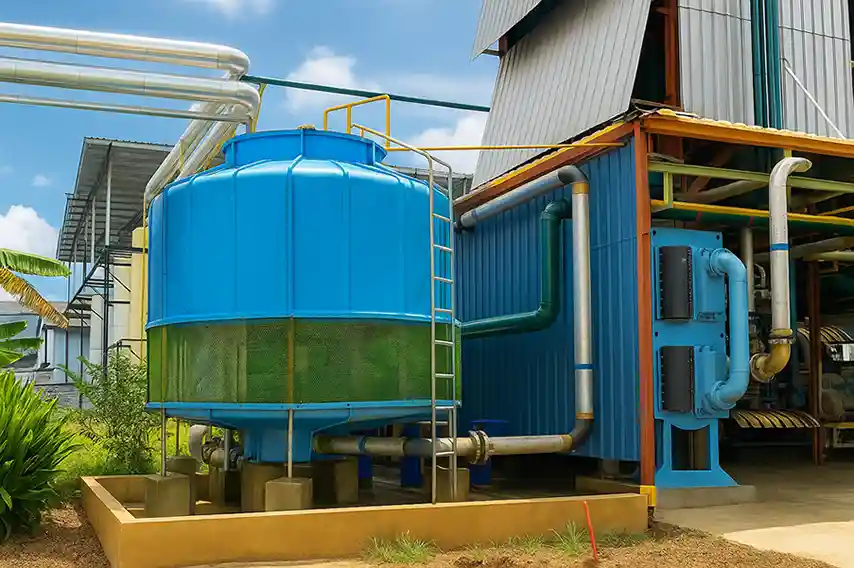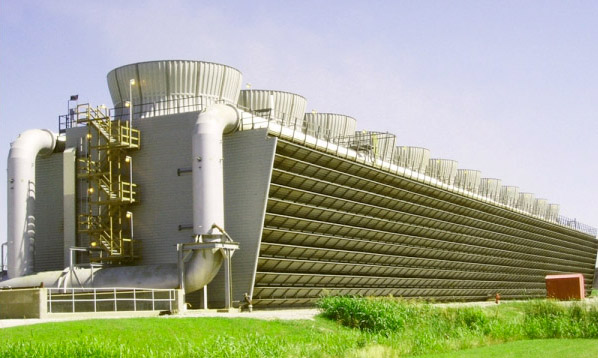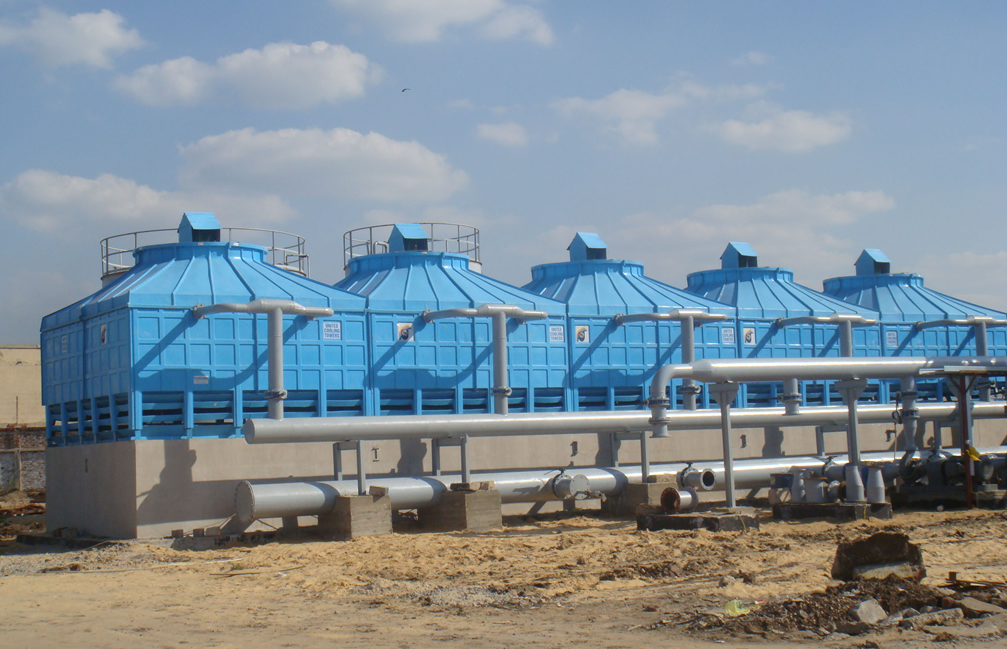
Most cooling towers sold in the United States are galvanized steel. They work, they are widely available, and for the first several years they perform much like anything else.
The difference shows up later.
We have been building cooling towers out of fiberglass reinforced plastic in Macon, Georgia since 1971, and the case for FRP comes down to what happens to a tower after a decade of sitting outdoors with water running through it.
What a cooling tower actually does to itself
A cooling tower is a box that combines everything that destroys metal. Constant moisture. Oxygen, moving fast, pulled through by a fan. Water chemistry that concentrates as it evaporates, driving up mineral content and pH swings. Chemical treatment to keep biological growth down. Full sun and UV exposure. Freeze and thaw cycles in winter.
Put galvanized steel in that environment and the zinc coating does its job — until it does not. Once it wears through, usually first at cut edges, weld seams, and fasteners, you have bare steel in a wet oxygenated box.
Corrosion typically starts in the basin, where water sits constantly. By the time you can see it from outside, the sheet metal underneath is often further gone than it looks.
What FRP does differently
Fiberglass reinforced plastic does not corrode, because there is no metal in the structure to oxidize. That single property drives most of the practical advantages.
No rust, pitting, or perforation. The shell and basin are not vulnerable to the water chemistry running through them.
No repainting or recoating. Galvanized towers are commonly recoated to extend their life. That is labor, material, and usually downtime, repeated across the tower’s service life. FRP does not need it.
Tolerates aggressive water. Facilities with high mineral content, elevated chlorides, or demanding chemical treatment programs are hard on metal towers. FRP is far less sensitive to what is in the water.
Stands up to coastal air. Salt air accelerates metal corrosion significantly. If you are near the coast — Florida, the Gulf, the Carolinas — this is often the deciding factor on its own.
Handles UV. Our FRP is formulated for continuous outdoor exposure.
Lighter. FRP weighs considerably less than an equivalent steel tower. That matters for rooftop installations where structural loading is a real constraint, and it lowers rigging and crane costs on installation day.
Where steel still makes sense
We would rather be straight with you than pretend there is no case for metal.
Very large towers. At the top end of the capacity range, field-erected steel and concrete structures dominate for structural reasons.
Extreme temperatures. Some high-temperature process applications exceed what standard FRP is rated for. If your water is running unusually hot, tell us and we will confirm suitability rather than sell you something that will not hold up.
Lowest possible upfront price. A basic galvanized tower may cost less to buy. If the equipment is going into a temporary installation or a facility you expect to exit in a few years, that can be the right call.
The FRP argument is a lifecycle argument. Over fifteen or twenty years, a tower that never needs recoating and does not perforate usually costs less to own — but that only matters if you plan to own it that long.
Stainless steel
Stainless resists corrosion far better than galvanized, and in some applications it is genuinely the right material.
It is also considerably more expensive, and stainless is not immune in cooling tower service. Chloride-induced pitting and stress corrosion cracking are real failure modes in high-chloride water, which is exactly the condition that concentrates in a recirculating tower over time.
For most industrial and commercial applications, FRP delivers comparable corrosion resistance at a lower cost.
Side by side
| FRP | Galvanized Steel | Stainless Steel | |
|---|---|---|---|
| Corrosion resistance | Does not corrode | Coating wears; steel corrodes | Good, but vulnerable to chloride pitting |
| Repainting or recoating | Not required | Periodic | Not required |
| Weight | Lightest | Heavier | Heaviest |
| Coastal / salt air | Well suited | Poorly suited | Suitable |
| Aggressive water chemistry | Well suited | Poorly suited | Depends on chlorides |
| Upfront cost | Moderate | Lowest | Highest |
| Typical failure point | Mechanical components | Basin and seams | Chloride pitting |
What still needs maintenance
FRP construction does not make a tower maintenance free, and anyone telling you otherwise is selling.
The shell and basin will outlast the moving parts. What you will still service over the tower’s life:
- Fan motors and drives — bearings wear, motors eventually fail
- Fill media — fouls, scales, and degrades; the most common replacement item
- Drift eliminators — degrade over time and let water escape as drift
- Spray nozzles and distribution — clog with debris and scale
- Float valves and basin hardware
You will also still need a water treatment program. Recirculating water concentrates minerals and supports biological growth regardless of what the tower is built from. FRP removes the corrosion risk to the structure; it does not remove the need to manage water chemistry.
We stock replacement parts for every model we build, including towers installed decades ago.
Our construction
Every CTS Model T-2 counterflow induced draft tower uses FRP for the shell and basin, from the 3-ton T-23 through the 1,500-ton T-3500.
Most models through the mid range ship completely assembled and packaged, which cuts field labor substantially — no assembling panels on site in weather.
Our FRP components are covered under our warranty.
Is FRP right for your application?
It is a strong fit if you are near the coast, running aggressive water chemistry, installing on a roof with loading limits, replacing a steel tower that corroded, or planning to keep the equipment fifteen years or more.
It is worth a conversation first if your process water runs unusually hot or your load exceeds our standard range.
Not sure which model you need? Start with our cooling tower sizing guide, or send us your flow rate, water temperatures, and location and we will confirm the selection.
Request a quote or call 800-752-1905.